
Saturday, August 8, 2026
  • English
  • Français
  • فارسی
  • عربى
PODCASTS
NCRI Women Committee Women Resistance Freedom
  • Home
  • NEWS
    • Women’s News
    • Articles
    • Statements
  • PUBLICATIONS
    • Monthlies
    • Documents
    • Reference Library
  • ABOUT US
    • The NCRI Women’s Committee
    • Gender Equality
    • Women’s Platform
  • MARYAM RAJAVI
    • Maryam Rajavi
    • Maryam Rajavi Speeches
    • The Plan on Women’s Rights and Freedoms
    • Ten-Point Plan for the future of Iran
  • VANGUARDS
    • The Fallen for Freedom
    • Heroines in Chain
    • Women of Iranian Resistance
    • Famous Women
    • Women in History
  • EVENTS
    • IWD Conferences
    • Activities
    • IWD Speeches
    • Solidarity
  • VIDEO
    • Videos
    • IWD Videos
  • PODCAST
  • DONATE
  • CONTACT US
No Result
View All Result
NCRI Women Committee Women Resistance Freedom
  • Home
  • NEWS
    • Women’s News
    • Articles
    • Statements
  • PUBLICATIONS
    • Monthlies
    • Documents
    • Reference Library
  • ABOUT US
    • The NCRI Women’s Committee
    • Gender Equality
    • Women’s Platform
  • MARYAM RAJAVI
    • Maryam Rajavi
    • Maryam Rajavi Speeches
    • The Plan on Women’s Rights and Freedoms
    • Ten-Point Plan for the future of Iran
  • VANGUARDS
    • The Fallen for Freedom
    • Heroines in Chain
    • Women of Iranian Resistance
    • Famous Women
    • Women in History
  • EVENTS
    • IWD Conferences
    • Activities
    • IWD Speeches
    • Solidarity
  • VIDEO
    • Videos
    • IWD Videos
  • PODCAST
  • DONATE
  • CONTACT US
No Result
View All Result
NCRI Women Committee
No Result
View All Result
Home Articles
The Feminization of Poverty in Iran: Female Heads of Household and Their Untold Struggles

The Feminization of Poverty in Iran: Female Heads of Household and Their Untold Struggles

October 16, 2024
in Articles

In this article, we commemorate the International Day for the Eradication of Poverty by exploring the plight of female heads of household in Iran and the additional pressures they face.

When discussing female heads of household, several key groups come to mind: widows, divorcees, the wives of addicted men, the spouses of incarcerated individuals, the wives of migrant workers, single self-sustaining women, and the wives of disabled or incapacitated men. All these women are compelled to support and manage their families. Meanwhile, the laws of the clerical regime in Iran officially categorize them as second-class citizens, existing solely to serve men. As a result, experts have long been highlighting the feminization of poverty in Iran.

Female Heads of Household: The Poorest Breadwinners

According to the National Statistics Center of Iran (NSC), there were nearly 4 million female heads of household in Iran in 2020. (mokhaberatema.ir, October 20, 2021)

The latest NSC report on household expenses and income for the year 2020 indicates that out of a total of 25,685,000 heads of household in the country, 3,517,000 were women. Notably, of these 3.5 million female heads of household, nearly 1.5 million were single self-sustaining women (living alone). In other words, approximately 13.7% of all heads of household in Iran are women, and about 41.5% of these women live independently. (mashreghnews.ir, April 9, 2022)

Nearly half of the female breadwinners belong to the poorest segments of society. According to official statistics, within the lowest income decile (the poorest), about 45% of heads of household are women. (salamatnews.com, October 20, 2021)

It is important to note that the Iranian regime lacks transparency regarding statistics. It must be assumed that the actual figures are significantly higher than those published by the NSC. For example, Ensieh Khazali, the former deputy for women’s and family affairs, stated in June 2022 that “unofficial statistics indicate that we have nearly 6 million female heads of household.” Before her, Tayebeh Siavoshi, a former member of the regime’s parliament, had indicated that the number could vary and reach up to 5 million. (ICANA.ir, August 7, 2017)

The Feminization of Poverty in Iran: Female Heads of Household and Their Untold Struggles

Female Heads of Household: A Minimal Share in the Job Market

In Iran, women face significant structural and social discrimination, making it exceedingly difficult for them to enter the job market and secure suitable, high-paying positions. As a result, many employed women are compelled to accept work in the informal sector, often in small workshops that operate without regulation, enduring grueling tasks for meager wages and long hours.

These women, grappling with numerous challenges in their lives, suffer from physical ailments due to working in unsuitable conditions. Many of them contend with back and neck issues resulting from strenuous labor.

Most female heads of household are either unemployed or hold part-time, informal jobs. Even those with formal employment earn very little, making it insufficient to sustain a basic standard of living. A substantial number of female heads of household struggle to cover daily living expenses, including rent deposits and other necessities, due to their limited incomes.

Female Heads of Household: The Silent Champions of Agricultural Lands

In Khuzestan Province, there are over 35,000 female heads of household, although unofficial sources suggest that this number may be higher. (Etemad daily, June 15, 2024)

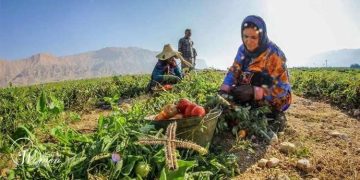
A significant portion of these women work in agriculture. In the city of Dezful alone, more than 5,000 women are employed in the agricultural sector. Ranging from teenage girls to women in their seventies, they labor in groups for a meager daily wage of only 200,000 tomans ($3.25). These women work alongside men but receive only 60% of their wages.

Most of them work without insurance. An 80-year-old woman stated that she had been farming without insurance for 60 years, enduring the scorching 50-degree heat of Khuzestan! If these women had been insured at such an age with that length of service, they should have retired twice by now.

In 2017, the Social Security Research Organization reported that women comprised 80% of the uninsured workforce.

Female agricultural workers often work double shifts and face various excuses from employers when it comes time to receive their wages. Some employers claim they lack the funds, while others make full payment contingent upon the complete sale of their produce; if their goods do not sell, they receive no payment at all.

Many women workers tragically lose their lives in road accidents while commuting to their jobs. In September 2022, 18 agricultural workers lost their lives when a minibus carrying them was involved in an accident on the roads of Shushtar. In the winter of 2024, a pickup truck carrying female agricultural workers overturned near Fazili Township in Dezful, injuring eight women. In June 2024, another incident involving the overturning of a pickup truck carrying female workers left seven injured.

Ali Ziaei, head of the crime scene investigation group at the forensic organization, reported in April 2024 that 2,115 workers had died and 27,000 had been injured due to work-related accidents in 2023. (Etemad daily, June 15, 2024) Unfortunately, there is no detailed data specifically regarding female workers.

The Feminization of Poverty in Iran: Female Heads of Household and Their Untold Struggles

Female Heads of Household: Street Vending for a Bite of Bread

Many female heads of household are compelled to engage in activities like street vending due to severe poverty and a lack of access to stable jobs. As the lower income brackets of society continue to grow poorer, the number of women resorting to street vending is increasing daily. These women often juggle their roles as mothers while bearing the responsibility of providing for their families.

Up until a decade ago, street vending was predominantly seen as a male occupation, with very few women taking to the streets to set up shop. However, today, the economic pressures and financial burdens placed on female heads of household are so overwhelming that street vending has become a well-established job for many of them. Wherever street vendors gather, women are an integral part of that scene.

Despite this reality, there is no accurate data on the number of female street vendors. The number of women engaged in this activity has doubled since the onset of the COVID-19 pandemic. (Arman-e Melli newspaper, June 7, 2024)

Asieh is a woman who has been making a living for the past five years by selling tea, coffee, and herbal infusions in Tehran’s Tajrish Square. Her husband is completely disabled, and she must also support her two daughters. Asieh remarked, “At first, working in the street was very difficult and embarrassing. But when you have nothing and no capital, you put aside your embarrassment and focus solely on feeding your children, even if it means street vending.”

Najmeh is another woman who began street vending four years ago due to her divorce and the responsibility of caring for her two children. The sun has severely weathered her face, reflecting the toll of her street vending work. Regarding the stress of her job, Najmeh said, “When municipal officers come to clear the area, they are so harassing that the cold, heat, and sunburn don’t even register.”

The Feminization of Poverty in Iran: Female Heads of Household and Their Untold Struggles

The Feminization of Poverty Amidst Harsh Economic Conditions

Under the rule of the clerics, Iranian society is becoming increasingly impoverished. According to the latest official statistics, the poverty line in Iran is set at 30 million tomans ($484), yet over 30 million people live below this threshold. (eghtesadonline.com, September 12, 2024)

In this context, not only workers and retirees but also government employees and most of the country’s salaried population are struggling to make ends meet. The minimum wage for workers in 2024 is reported at 7 million tomans ($113), while the pension for retirees is set at 9 million tomans ($145). (sepidarsystem.com, May 20, 2024) This is assuming these wages are actually paid, as workers and retirees frequently endure several months without receiving even these minimal amounts due to the depleted state of the government treasury and relevant ministries.

In such dire economic circumstances, with high unemployment rates, the situation is even worse for women, who face discrimination in hiring and employment. Some female heads of household in Kurdistan, Kermanshah, and Hormozgan provinces resort to porter work (koolbari) to meet their families’ expenses. In some cases, the pressure from the lack of suitable jobs and the necessity of providing for their children’s health and education drives female heads of household to engage in unconventional activities, such as selling organs or even prostitution.

According to a government expert, the feminization of poverty is a very dangerous issue. A society trapped in chronic female poverty cannot be expected to demonstrate high tolerance. (Rouydad24.ir, June 2, 2024)

The clerical regime has no plans to improve the economic conditions for the people, especially for women, nor does it wish to. By keeping the population impoverished, the regime aims to keep people preoccupied with meeting basic daily needs, hoping to prevent any uprising against its oppressive rule. However, this strategy is a grave miscalculation.

Iranian society has become a powder keg, and despite the severe and ruthless repression by the clerics, there have been at least five major nationwide uprisings over the past seven years. All evidence points to an approaching day when the final surge of popular anger will erupt, sweeping the ruling religious tyranny from the pages of Iranian history once and for all.
Tags: PovertyWomen Heads of Household
ShareTweetPinShareSendShareShare

Related Posts

The Hidden Victimization and Exploitation of Widows in Iran

July 23, 2026
The Hidden Victimization and Exploitation of Widows in Iran

Exploitation of widows in Iran Introduction: The survival of the mullahs' regime rests on two fundamental pillars: overt suppression in society and institutionalized misogyny within its laws. The...

Read moreDetails

Erased After Loss: The Untold Story of Widows in Iran

July 21, 2026
The Untold Story of Widows in Iran

Inside Iranian Regime's System of Discrimination Against Widows Welcome to another episode of podcasts of the Women's Committee of the National Council of Resistance of Iran. Imagine waking...

Read moreDetails

Widows in Iran: An Analysis of Legal Challenges and the Structure of Discrimination

July 17, 2026
Widows in Iran: An Analysis of Legal Challenges and the Structure of Discrimination

Introduction: In the political and legal structure governing Iran, misogyny and gender discrimination have been institutionalized as a fundamental principle, heavily impacting the fabric of family and society....

Read moreDetails

The Ineffectiveness of Population Policies in Iran: Economy, Aging, and the Overlooked Rights of Women

July 10, 2026
The Ineffectiveness of Population Policies in Iran: Economy, Aging, and the Overlooked Rights of Women

Abstract: A compilation of official data, media reports, and disclosures published in April, May, and June 2026 demonstrates that Iran is grappling with a multi-layered demographic crisis. This...

Read moreDetails

Iran’s Escalating Water Crisis: Energy Imbalance, Popular Protests, and the Role of Women

June 19, 2026
Iran's Water Crisis: Energy Imbalance, Popular Protests, and the Role of Women- Part 2

The water crisis in Iran has transcended a mere natural challenge, evolving into a human, environmental, and economic catastrophe. While the regime has for years attempted to attribute...

Read moreDetails
Next Post
Marzieh Doshman Ziari A Promising Young Woman Killed for Her Dream of Freedom

Marzieh Doshman Ziari

Documents

Call for Immediate Action to Halt the Death Sentence of Arghavan Fallahi

Sign our Statement to Halt the Death Sentence of 25-Year-Old Political Prisoner Arghavan Fallahi

July 10, 2026

Statement Calling for Immediate Action to Halt the Death Sentence of 25-Year-Old Political Prisoner Arghavan Fallahi We express our profound...

The Ineffectiveness of Population Policies in Iran: Economy, Aging, and the Overlooked Rights of Women

The Ineffectiveness of Population Policies in Iran: Economy, Aging, and the Overlooked Rights of Women

July 10, 2026

Abstract: A compilation of official data, media reports, and disclosures published in April, May, and June 2026 demonstrates that Iran...

Crushed by Design: Structural Crises and Inequitable Policies Push Female-Headed Households to the Edge

Crushed by Design: Structural Crises and Inequitable Policies Push Female-Headed Households to the Edge

May 18, 2026

Introduction Life for the Iranian people under the religious dictatorship is fraught with hardship and peril from every perspective. Whether...

Monthlies

July 2026 Report: Death Sentences for Women Rising Up to Overthrow the Mullahs' Regime
Monthlies

July 2026 Report: Death Sentences for Women Rising Up to Overthrow the Mullahs’ Regime

July 31, 2026
June 2026 Report: Working Iranian Women Erased from Labor Market
Monthlies

June 2026 Report: Working Iranian Women Erased from Labor Market

July 5, 2026
May 2026 Report: The Enduring Resistance of Iranian Women
Monthlies

May 2026 Report: The Enduring Resistance of Iranian Women

May 31, 2026
April 2026 Report: Mass Arrests of Women: Targeted Repression in Time of Crisis
Monthlies

April 2026 Report: Mass Arrests of Women in Iran

April 30, 2026

Articles

Sexual Apartheid in the Laws of Iran’s Clerical Regime – part 1

Sexual Apartheid in the Laws of Iran’s Clerical Regime – part 1

August 6, 2026

Sexual Apartheid in the Medieval Laws of the Clerical Regime At a time when the world is moving toward the...

Women's Sports Clubs Sealed amid the Unemployment Crisis in Iran

Women’s Sports Clubs Sealed amid the Unemployment Crisis in Iran

August 5, 2026

Four women's sports clubs in the city of Yazd have been sealed off by the Public Places Supervision Police. This...

The 1988 Massacre: The Greatest Unpunished Crime Against Humanity

The 1988 Massacre: The Greatest Unpunished Crime Against Humanity

July 28, 2026

The Glorious Epic of Resistance by PMOI Women in the Anti-Human Clerical Regime's Prisons The massacre of over 30,000 political...

The Fallen for Freedom

Shiva Bordbar Javid
The Fallen for Freedom

Shiva Bordbar Javid

August 4, 2026
Fatemeh Alizadeh, a 28-year-old pregnant woman
The Fallen for Freedom

Fatemeh Alizadeh

July 29, 2026
Sahar Bayat was killed on January 8, 2026
The Fallen for Freedom

Sahar Bayat

July 23, 2026
Saba Negahban, known as "Venus," was killed on Friday, January 9, 2026, by direct fire from the regime’s suppressive forces
The Fallen for Freedom

Saba Negahban

July 22, 2026

ABOUT US

NCRI Women Committee

We work extensively with Iranian women outside the country and maintain a permanent contact with women inside Iran. The Women’s Committee is actively involved with many women’s rights organizations and NGO’s and the Iranian diaspora.
The committee is a major source of much of the information received from inside Iran with regards to women. Attending UN Human Rights Council meetings and other international or regional conferences on women’s issues and engaging in a relentless battle against the Iranian regime’s misogyny are part of the activities of members and associates of the committee.

CATEGORIES

  • Activities
  • Articles
  • Documents
  • Famous Women
  • Heroines in Chain
  • IWD Conferences
  • IWD Speeches
  • IWD Videos
  • Maryam Rajavi
  • Maryam Rajavi Speeches
  • Monthlies
  • Podcast
  • Reference Library
  • Solidarity
  • Statements
  • The Fallen for Freedom
  • Videos
  • Women in History
  • Women in Leadership
  • Women of Iranian Resistance
  • Women's News

BROWSE BY TAG

Child marriage coronavirus education execution forced hijab Gender Gap Generation Equality Honor killings Iran Teachers Maryam Akbari Monfared Nurses Plan on Women's Rights and Freedoms Poverty Prisoners Protests rural women Saba Kord Afshari The girl child Violence against women Women's Leadership Women Heads of Household Zeinab Jalalian

The copyright of all the material published on this website has been registered under © 2016 the Women’s Committee of the National Council of Resistance of Iran. To obtain permission to copy, redistribute or publish the material published on this website, you should write to the NCRI Women’s Committee. Please include the link of the original article on our website, women.ncr-iran.org.

Welcome Back!

Login to your account below

Forgotten Password?

Retrieve your password

Please enter your username or email address to reset your password.

Log In

Add New Playlist

No Result
View All Result
  • Home
  • News
    • Women’s News
    • Articles
    • Statements
  • Publications
    • Monthlies
    • Documents
    • Reference Library
  • About Us
    • The NCRI Women’s Committee
    • Gender Equality
    • Women’s Platform
  • Maryam Rajavi
    • Maryam Rajavi
    • Maryam Rajavi Speeches
    • Ten Point Plan for Iran
    • The Plan on Women’s Rights and Freedoms
  • Vanguards
    • The Fallen for Freedom
    • Heroines in Chain
    • Women of Iranian Resistance
    • Famous Women
    • Women in History
  • Events
    • IWD Conferences
    • Activities
    • IWD Speeches
    • Solidarity
  • Video
    • Videos
    • IWD Videos
  • Podcast
  • DONATE
  • Contact us
  • فارسی
  • عربی
  • Français

The copyright of all the material published on this website has been registered under © 2016 the Women’s Committee of the National Council of Resistance of Iran. To obtain permission to copy, redistribute or publish the material published on this website, you should write to the NCRI Women’s Committee. Please include the link of the original article on our website, women.ncr-iran.org.