


How Forced Marriage and Iran’s Misogynistic Laws Continue to Claim Women’s Lives
The killing of two child marriage victims in a single day has once again exposed the deadly consequences of forced marriage in Iran. Sogand Moshtareki, a 14-year-old child mother in Kerman Province, and Sepideh Raeisi, a 21-year-old pregnant woman in Fars Province, were both forced into marriage as children and were ultimately killed by their husbands. Their cases are not isolated incidents but part of a broader pattern of violence against women sustained by discriminatory laws, a patriarchal system, and the impunity enjoyed by many perpetrators in Iran.
These crimes are not isolated incidents. They are part of a continuing cycle of violence sustained by discriminatory laws, the ruling regime’s patriarchal power structure, and the effective impunity enjoyed by perpetrators of violence against women.
Two Victims of Child Marriage in One Day
On Friday, November 6, 2026, Sogand Moshtareki, a 14-year-old girl from Kerman Province, was beaten to death by her husband.
She had been forced into marriage at the age of 13 and had given birth only days before her murder.
Sogand had recently survived a traffic accident while being transported for childbirth. She survived that ordeal and safely delivered her baby, only to lose her life shortly afterward at the hands of her husband.
Following the murder, the suspect was arrested and reportedly claimed that the motive was “family disputes.”
On the same day, Sepideh Raeisi, a 21-year-old woman from Fars Province, who was four months pregnant and the mother of a three-year-old child, was shot and killed by her husband.
Her four-month-old unborn child was also killed in the attack, while her mother was wounded.
Sepideh had endured years of threats, intimidation, and domestic violence at the hands of her husband, Ali Raeisi, a member of Iran’s Revolutionary Guard Corps (IRGC), before he ultimately murdered her.
Like Sogand, Sepideh had been forced into marriage at the age of 13 and had endured years of threats, intimidation, and domestic violence.
Seeking safety for herself and her young child, she had decided to pursue separation and divorce. Instead of finding protection, she was murdered by her husband in front of family members. (Rokna, November 10, 2026).
Child Marriage: A Path That Leads to Violence and Death
The common thread linking these two cases is not merely that both women were killed by their husbands.
Both victims entered marriage as children, deprived of the ability to make independent decisions about their lives. Sogand was forced into marriage at 13, and Sepideh was also married off at the age of 13, when both were still children.
Child marriage is not a cultural tradition. It is a form of structural violence against girls.
Girls forced into marriage are denied their rights to education, personal development, and free choice. Many become vulnerable to domestic violence, early pregnancy, economic dependency, and, in some cases, lethal violence.
Sogand and Sepideh’s stories illustrate this reality with tragic clarity.
One was murdered at the age of 14, only days after becoming a mother. The other lost her life, along with her unborn child, after years of abuse and while attempting to escape a dangerous marriage through divorce.
A Patriarchal System That Enables Violence Against Women
These murders cannot be dismissed as merely the actions of individual men.
They occur within a system that grants men authority over women and subordinates women’s rights to the will of fathers, husbands, and other male relatives.
Under the legal framework of Iran’s ruling clerical regime, girls can still be forced into marriage at a young age under the protection of discriminatory laws.
Such laws create and reinforce unequal relationships from the outset. When a child is pushed into marriage instead of remaining in school and enjoying her fundamental rights, the risk of exploitation and violence increases dramatically.
In the case of Sepideh Raeisi, seeking separation from her husband did not provide safety. Instead, her attempt to escape violence became the trigger for her murder.
This reality demonstrates that for many women in Iran, trying to leave an abusive relationship can itself become a life-threatening act.
Why Do Perpetrators Feel Immune?
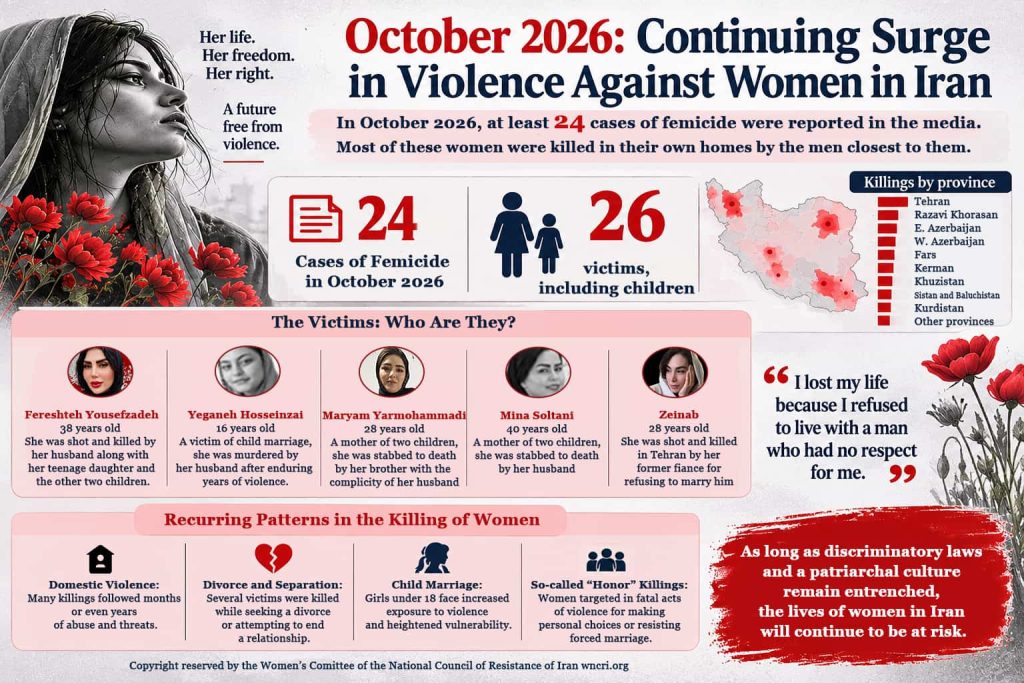
According to the monthly report issued by the Women’s Committee of the National Council of Resistance of Iran on the killing of women in October 2026, numerous women and girls were murdered within a short period by husbands, fathers, brothers, or other male relatives.
The report underscores that many perpetrators commit such crimes knowing that legal protections for women are weak and that punishment often fails to act as a deterrent.
Under such circumstances, the central question is not only why these men kill, but why perpetrators feel such a strong sense of security and impunity.
Provisions within Iran’s Islamic Penal Code that provide special exemptions, reduced penalties, or legal protections for certain forms of family violence send a clear message: women’s lives and safety enjoy little protection under the law.
Victims Who Must Not Be Forgotten
Sogand Moshtareki was only 14 years old.
Sepideh Raeisi was only 21 years old and was raising a three-year-old child while carrying another life in her womb.
Both were forced into marriage as children.
Both were ultimately killed by their husbands.
Their murders once again demonstrate that child marriage and forced marriage are not merely violations of children’s rights. They are practices that can lead directly to deadly violence against women.
As long as discriminatory laws, patriarchal norms, and the impunity of perpetrators remain intact, more girls and women will continue to face the same fate.