
Prison Memoirs of Azam Haj-Heydari from the book The Price of Being Human — Part Twenty-Three
After enduring more than seven months of imprisonment in the “Cage” ward, where female PMOI prisoners were held in individual enclosures, blindfolded and cut off from all information about the outside world, the day finally came when the cage nightmare ended.
In this section of her memoirs, Azam Haj-Heydari recounts the moment their blindfolds were removed, the joy of seeing her comrades again, and the feeling of victory after months of resistance— a story of women who refused to surrender under the most brutal conditions and ultimately made their enemies confront the strength of their resistance.
Azam Haj-Heydari, a political activist and political prisoner of the 1980s, recorded her years in prison in her memoir The Price of Being Human. In this section, she describes the end of the Cage nightmare, what she calls the defeat of the “Resurrection” ward, and the moment when, after months, she saw the faces of her comrades again and realized that what the executioners had designed to break the prisoners’ spirit had failed.
When the Blindfolds Came Off After Seven Months
The Cage ward continued for more than seven months, until one day representatives of Montazeri came to prison and entered the Cage ward. They spoke with one or two of the girls. They asked one of them, “Tell me, what’s going on here?”
She replied, “I’m blindfolded. How am I supposed to know what’s going on? You aren’t blindfolded—look around and see what’s going on!”
The same mullah then came over to me and said, “Don’t blame these things on Islam. We’ve come here to investigate the situation.”
This happened at the same time as the regime’s apparent removal of Lajevardi, the executioner. It seemed that, having failed to achieve what they wanted, the regime was trying to put on a show that things had changed.
But despite Lajevardi’s apparent departure, his office was still on the third floor of the Prosecutor’s Office, and people who had occasion to go there after their release had seen him there many times.
In any case, that day the group talked to us, filmed the whole scene, and left.
Three days later, while we were still sitting there, they came and removed the boards and took off our blindfolds.
After seven months, we could finally see one another.
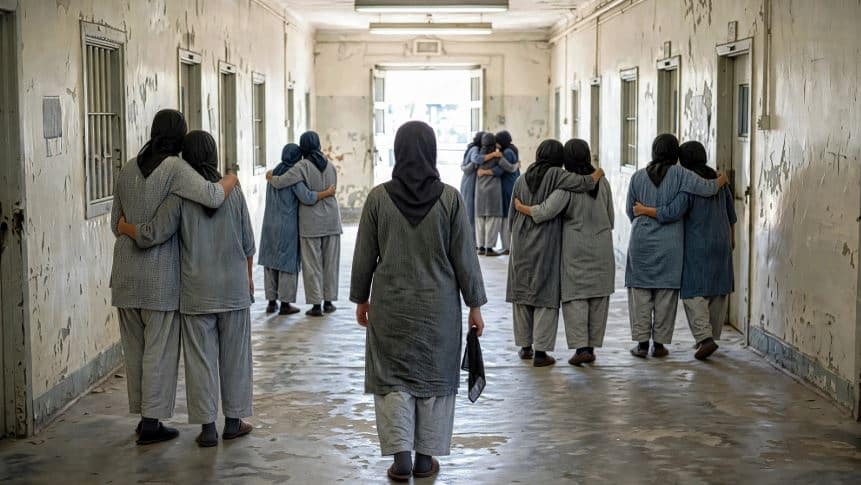
When I took off my blindfold, I suddenly saw Shouri standing in front of me, smiling. I looked to the other side and saw Hengameh smiling at me with that same mischievous look of hers.
It was unbelievable.
It was the most beautiful sight I could possibly have seen after seven months of being blindfolded!
It was as if they had given me the whole world.
I smiled back at them. A little farther away, I saw my dear Sepideh sitting there, communicating with me and the other girls from across the room with her eyes.
She was saying, “Girls, do you see? We won!”
As I stood there silently looking at them, I began to cry with happiness.
After the agents left and we were alone, Shouri came over, put her arms around me, and said, “Azam! Why are you crying?”
I rested my head on her shoulder and let myself cry.
She gently stroked me and said, “See? It’s over!”
I told Shouri, “I’ve forgotten everything. I’m like someone with a mental disability!”
She lifted my head and looked into my eyes.
I will never forget her kind face or the light in her eyes—the light of determination, willpower, and absolute resolve.
She said, “Azam, you’re crying? Crying isn’t for a PMOI member! Nothing has happened!”
Shouri was a doctor. When I told her a little about my physical condition, she listened to me patiently and kindly and said, “It’s all from physical weakness caused by not eating. All your strength and your memory will come back to you…”
I said, “I’ll take back the tears I cried for myself but accept the tears I shed from happiness at seeing all of you!”
She laughed sweetly.
Hengameh was on my other side, constantly trying to speak to me with her eyes. The other girls were doing the same, communicating with one another through their looks.
They were telling one another the story of those seven months—a story that could not be put into words—through a language without words.
A story that could be summed up in one sentence:
Fighting to remain human.
I got up and began looking at the other girls.
Whenever they saw one another, each would involuntarily let out a muffled cry of shock and happiness:
“Good God! What happened to you?”
They were right. In those seven or eight months, the girls had aged and become so worn down that they looked fifteen or twenty years older.
There was no mirror, so no one had seen her own face or physical appearance. Each woman felt sorry for the others, without realizing that the same thing had happened to her.
Every time I saw one of the girls, I felt my heart opening up.
Because I couldn’t sit down, I walked around.
I went farther over and saw Hengameh. We had been together throughout the entire time in the Cage. She was as lively and spirited as ever, talking rapidly and loudly, making a commotion, joking with this person and that, and imitating Haji.
I was afraid there might be one of the traitors around who would report her again and get her into trouble with Haji, so I said, “Girl, hold your tongue for a little while. Let’s first see what’s going on in the world!”
With her usual defiant spirit, she said, “Oh, leave me alone! What do you and I have left that Haji could possibly take away from us? After everything they’ve already done to us, what else can they do?”
She continued making a commotion, and I was enjoying every minute of it.
Just seeing them seemed to give me life again. It was as though my cells were being filled once more with some vital substance.
My whole heart was overflowing with happiness that we had all defeated the enemy despite all their depravity, and I was filled with pride and honor at being among such heroic women.
Whenever I looked at any of the girls, a whole world of words seemed to be moving across their faces and in their eyes, where laughter and tears mingled.
It was as though they, too, were saying to one another with their hearts and their eyes:
“Lajevardi, look at how disastrously your criminal theory has failed!
Look at how we have rubbed your face in the dirt!”
And I was saying to Haji Rahmani:
“You cowardly fool! Why have you gone into hiding now? Why aren’t you boasting anymore? Come and see who the real heroes are!”
I was counting the minutes until we could get back to the ward and see the other girls there.
We had always heard recordings of the meetings held in the corridor of Unit 3, the women’s unit, where they would tell the girls:
“There is a place like the Day of Resurrection…”
They wanted to create a nightmare with those words and break the prisoners’ resistance in the wards.
That was why I wanted to get back to the ward as quickly as possible and tell them the story of the defeat of the “Resurrection” ward.
How I had missed every single one of them. I felt that I had a whole world of things to tell each of them. They must have had so much to tell me, too. Surely so many things had happened in the ward…
And so, this seven-and-a-half-month hell, this “Day of Judgment,” which was in reality an unrelenting war between Khomeini and the PMOI, came to an end with our victory and the enemy’s definitive defeat.
The enemy, with its utter disregard for humanity, had designed this ward believing that within a week—or at most a month—all the imprisoned PMOI members would be driven to desperation and remorse, and would raise their hands in surrender and repentance.
Lajevardi, the executioner, who had gained nothing from all the executions he had carried out, thought the problem was that he did not have enough solitary-confinement cells.
He believed that if he placed everyone under solitary-confinement conditions, within a month there would no longer be a single prisoner who remained steadfast.
That was why they created the “Resurrection” ward, with its cages and coffin-like enclosures, where the conditions were far more horrific than those of solitary confinement.
But in the end, it was they who were disgraced.
They were forced to admit their defeat and, at least outwardly, remove Lajevardi from public view for a while, hoping that this would somehow lessen the disgrace he had brought upon them and allow them to change the scene.
After all, they knew only contemptible creatures like themselves. They knew nothing about human beings or the power of a person who has made the decision to resist and remain a PMOI member.
To be continued…