
September 15, International Day of Democracy, offers a vital moment to evaluate the true benchmarks of freedom, human rights, and popular governance. In any society, the ultimate measure of democracy and progress lies in the equal participation of women in politics—specifically within political leadership.
Five decades of struggle against religious tyranny in Iran demonstrate a clear reality: democracy can only be genuine and sustainable when women not only possess equal rights but also play a decisive role in leadership and political decision-making.
Women as the Engine of Change and the Rejection of Dictatorship
Over the past five decades, Iranian women have proven to be the primary force and vanguard of change. They played a pivotal role in the 1979 Revolution, joining demonstrations against the Shah in the millions for the first time. Yet, from the earliest days of the post-revolution era, the ruling religious dictatorship began stripping women of their fundamental freedoms under the guise of “compulsory hijab.” The regime recognized that to shackle an entire society, it first had to subdue the women who carried its most progressive demands.
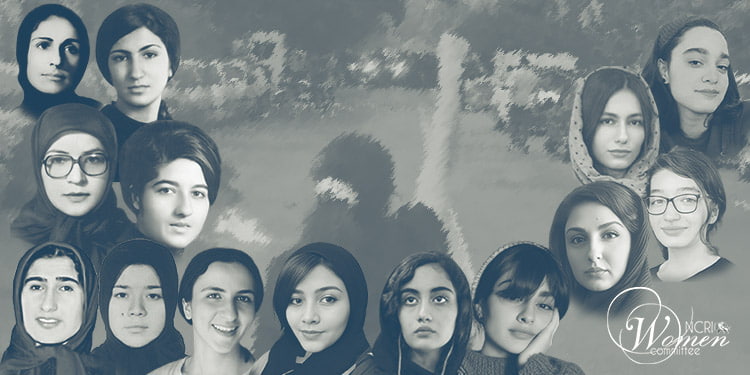
Following the suppression of broader democratic freedoms, the mullahs’ regime ushered in a dark era of repression during the 1980s. This began with the unprecedented execution of 12 teenage girls whose identities had not even been verified. Tens of thousands fell victim to execution squads, including girls as young as 10 and 13, pregnant women, and mothers over the age of 70.
Iranian women have paid an immense price to resist religious tyranny, taking on formidable responsibilities and guiding the resistance movement through intricate, hostile conditions. In recent years, they have actively stood at the forefront of nationwide protests and uprisings. They have proven beyond doubt that women’s participation is indispensable to the struggle against religious dictatorship.
Today, Iranian women resolutely reject both the misogynistic regime of Velayat-e Faqih (absolute rule of the jurisprudent) and all forms of authoritarian, patriarchal structures—whether monarchical or religious.
How Women’s Leadership Shapes the Outcome of Overthrowing Tyranny
At historic turning points when societies stand on the precipice of fundamental change, the ultimate success of overthrowing a dictatorship depends entirely on the character of the political alternative. The definitive benchmark for assessing any political movement is its stance on women’s rights and their inclusion in leadership.
Women in leadership serves as the ultimate litmus test, distinguishing a truly democratic alternative from the mere reproduction of authoritarianism. A government built on gender discrimination cannot become democratic simply by changing its name or shuffling figures in power. If the underlying structure remains rooted in domination, monopoly, and exclusion, a change of regime will fail to transform power relations.
Thus, women’s active participation in political leadership is the defining feature separating a genuine democratic alternative from authoritarian systems. Any political force asserting a commitment to a democratic society must answer four straightforward questions:
- Do women hold a real presence in its leadership and political decision-making bodies?
- Has it translated gender equality into an operational principle, rather than mere rhetoric in statements?
- Does it fully recognize a woman’s right to free choice?
- Is it prepared to redefine political power around the equal participation of men and women?
Democracy cannot be forged through the same political culture that marginalizes half of the population. This is perhaps the most critical political takeaway of the International Day of Democracy for Iran.
If a future Iran is to be established on individual and social freedoms, human rights, equal citizenship, the separation of religion and state, and equal rights for all ethnic groups and nationalities, integrating women into political leadership cannot be deferred to tomorrow.
Far from being anti-male, female leadership represents an emancipatory transformation designed to dismantle sexist ideology and systems of domination. Experience within the Iranian Resistance shows that embracing women’s leadership can also transform relationships among men—shifting them away from competition and dominance toward solidarity, brotherhood, and shared responsibility.
The Dawn of Democracy Led by Women
On this International Day of Democracy, the message from Iran’s resilient, politically conscious women to the global community is clear: the era of oppressive, misogynistic regimes is over.
Women’s leadership is not an afterthought to be postponed until after a regime falls. It is the very engine driving change, the compass guiding the struggle, and the sole guarantee of a peaceful, democratic, and lasting transition of power to the people.
Driven by a generation of courageous women and equality-minded men, Iranian society has set off on a path that will culminate in the downfall of religious tyranny and the dawn of democracy, freedom, and equality across the nation.
This captures the essential bond linking women, freedom, and democracy in contemporary Iran: women’s freedom is not an offshoot of democracy—it is its core. And women in leadership remains the true test of democracy in Iran.