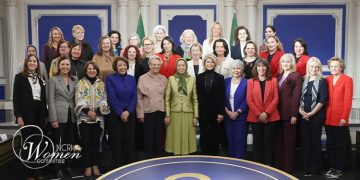

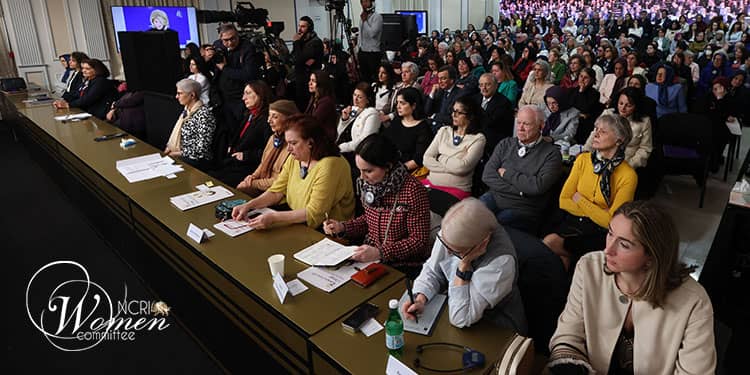
On Saturday, February 21, 2026, on the eve of International Women’s Day, the NCRI Women’s Committee hosted an international conference in Paris entitled “Women’s Leadership: An Imperative for a Free Iran and a Democratic Republic.”
The conference, attended by women legislators, academics, thinkers, and prominent political figures, focused on women’s political participation and leadership as a decisive element in a democratic society.
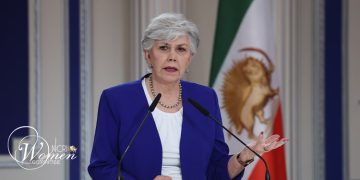
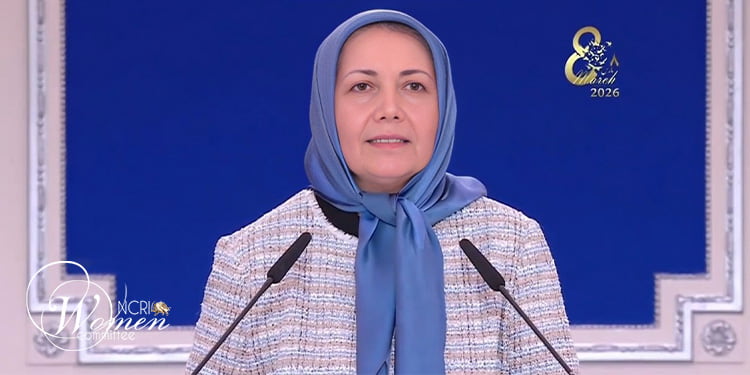
The conference opened with remarks by Ms. Sarvnaz Chitsaz, Chair of the NCRI Women’s Committee, the text of which follows:
Sarvnaz Chitsaz: Iran’s Future Is Neither Monarchy nor Religious Dictatorship, but a Free and Equal Republic Based on the Will of the People
Distinguished guests,
Dear sisters, friends, and supporters of the Iranian Resistance,
I warmly welcome all of you. I am deeply honored and grateful for the presence of each and every one of you at the 2026 Women’s Conference.
I especially want to thank my dear sisters from Iranian women’s associations who have traveled from near and far to join us today.
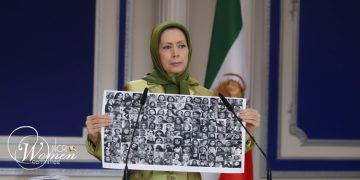
I am also deeply thankful to Mrs. Maryam Rajavi for being here with us at this conference. And I am honored to announce that our dear sisters in Ashraf-3 are joining us in this meeting. I send my greetings and respects to all of them, and I am truly delighted and proud to see them with us.
Dear friends,
This year we mark International Women’s Day under heartbreaking circumstances. During the January uprising, thousands of women, men, and young people were massacred in the streets by the regime’s forces.
So far, the People’s Mojahedin Organization of Iran (PMOI) has announced the names of 2,411 martyrs, including 259 women and 174 teenagers and children. These numbers represent an enormous crime.
Even more disturbing is how the regime tried to hide it by shutting down the internet and imposing a total information blackout.
We have seen this before in the 1980s, especially during the 1988 massacre of political prisoners. The world did not fully see what was happening to the Iranian people and to the People’s Mojahedin Organization of Iran. But let me say this clearly: we neither forget nor forgive these crimes.
This misogynistic regime believes it can break the Iranian people through fear, killing, mass arrests, secret prisons, torture, and death sentences. The regime thinks that by showing black body bags and spreading terror, it can silence a nation.
But our struggle did not begin last January. It began on June 20, 1981. For decades, our people have endured pain, sacrifice, and bloodshed. And today, we are closer than ever to the end of this long road, a road that leads to freedom.
In every uprising, despite brutal repression, the Iranian people, women, men, young and old, have demanded only one thing: freedom, justice, equality and an end to all forms of dictatorship. Their message is simple and clear: no to the Shah, no to the Mullah.
Iran’s future does not lie in a return to monarchy, nor does it lie in the current religious dictatorship. Iran’s future lies in freedom, equality, and a republic based on the will of the people.
And to those who believe they can claim ownership of the Iranian people’s century-long struggle for freedom, including the son of the former Shah, let it be clear: the Iranian people have already answered. During the 2019 uprising, they chanted, “Death to the oppressor, whether Shah or Supreme Leader.”
The regime is on a downward path. The struggle continues.
And the time has come for all outdated dictatorial forces, whether from the past or the present, to be left behind. The true resistance of the Iranian people represented by the People’s Mojahedin Organization and the National Council of Resistance of Iran offers a clear and a practical path forward.
Through Maryam Rajavi’s Ten-Point Plan, we see a real vision for democracy, equality and a democratic republic.