
Prison Memoirs of Mehri Hajinejad from “The Last Laughter of Leila”– Part Nineteen
In the previous part of the prison memoirs of Mehri Hajinejad, we read about the regime’s attempts at ideological indoctrination through forced classes inside Khomeini’s prison. In this section, the author turns to one of the darkest chapters of the Iranian prison system, exposing previously undisclosed crimes and the unimaginable cruelty used to break politically resistant prisoners.
Sentencing After Three Years
It was the spring or summer of 1984 when one day the prison guard came to the door of our ward, read out several names, including mine, and said, “Sign these papers.”
They were our sentencing notices. Mine stated: five years definitive imprisonment and three years suspended, with bail set at three million tomans.[1]
Only then did it become clear that after three full years in prison, they had finally issued a sentence for me. My main fear upon receiving it was that they might transfer me to Qezel-Hesar Prison,[2] which would mean losing the atmosphere of Evin, the direct confrontation with the enemy, and years of being alongside my longtime comrades.
A few months later, in the fall of 1984, one day they called my name along with about forty others and told us to prepare for interrogation. It was strange; we were all detainees from 1981 and had no connection to one another. When we reached the prosecutor’s building, it turned out they simply wanted to photograph us with prison number placards.
After more than three years in prison, they had suddenly remembered to take our photos.
They took three pictures of each of us from different angles. When they hung the placards around our necks, I remember dear Aghdas laughing and saying, “How nice— they’ve finally awarded us our Mojahed medals!”
Suppression and Unimaginable Cruelty
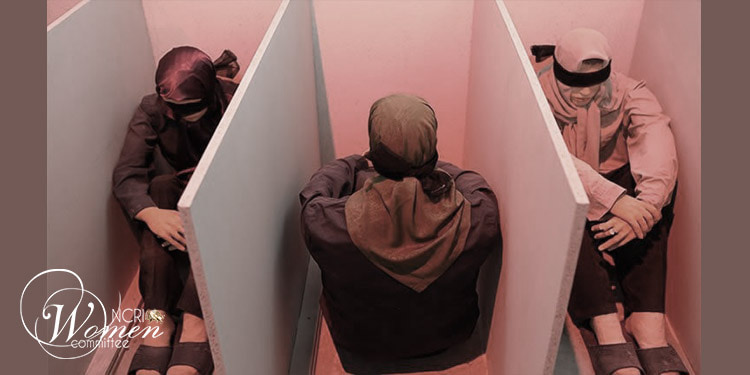
In 1984 and 1985, the regime intensified its focus on crushing resistant prisoners through limitless physical and psychological torture. Under the pretext of “destroying prison organizational structures” in Qezel-Hesar, they created so-called residential units and cages, which later proved to be underground chambers of terror where women and men were tortured in order to annihilate their human identity.
Inside the cages, prisoners were forced to remain in a squatting position for 24 hours a day, completely silent and motionless. They could neither stand nor lie down nor make a sound. This continued until the prisoner repented and publicly renounced the organization.[3]
From early morning until late at night, loudspeakers blasted regime mourning chants and religious dirges, deliberately creating an atmosphere of grief, wailing, and psychological collapse. Guards stood over prisoners, beating them at the slightest movement. Some were deprived of sleep for more than two weeks, while being subjected to relentless psychological torture designed to erase all traces of human dignity.
In Gohardasht Prison,[4] places known as the “dark room” and the “kennel” were established, spaces whose horrors defy description. I only learned fragments of what happened there from what my mother later told me, after a rare meeting with my brother Ali, who had been held in the dark room.
In Evin Prison, especially Ward 209,[5] a new wave of interrogations and torture began, interrogations that often ended in execution. At the time, very little of this reached the outside world. Almost no one knew what was happening inside Iran’s prisons.

Unexposed Crimes
In Qezel-Hesar, a significant number of prisoners were tortured to death in the residential units or cages. Others lost their sanity. Only a small number of steadfast prisoners survived, taking advantage of a temporary rift between regime factions over prison policy to escape the cages.
Those who survived entered the general wards suffering from chronic illness and unbearable pain. Their appearances had changed dramatically, many looked more than ten years older, some so emaciated they were barely recognizable. They entered the wards, bent and broken.
Yet when they arrived, they were greeted as heroes. The moment of their return caused an indescribable upheaval. Fellow prisoners wept openly, embracing them, covering their faces with kisses. One eye cried tear of joy; the other wept blood over what the executioners had done to these captives.
Only after the cages were dismantled did it become clear that many of those who had remained loyal to their vows inside the cages, those who had said no to the executioners, had been killed.
In the cages, a prisoner had only one right: the right to stand up and declare that they had broken with the organization and the struggle. Standing meant surrender. Remaining seated meant resistance.
And there were heroes who remained seated for months, nearly a year, blindfolded the entire time, never surrendering. Just as in 1988 the regime separated Mojaheds from non-Mojaheds with a single word,[6] in the cages the distinction was made by sitting or standing.
Names That Still Hurt
Shiva, a beloved comrade of mine, a chemistry graduate and a true genius, had completely lost her psychological balance by the time I saw her after the cages were dismantled. Remembering her has always been painful.
Azam, another comrade, a schoolteacher in her mid-twenties, looked like a forty-year-old woman. After months of squatting, her back remained bent for a long time.
Farank, a high-school student from Tehran, had become completely mentally ill. There were many such victims.
There were also teenage twin sisters, sixteen or seventeen years old, arrested during the June 20 demonstrations.[7] Both were placed in cages. One lost her sanity due to the torture in the residential unit. She screamed at night, laughed hysterically, threw food dishes, and created chaos throughout the ward.
The guards were too afraid to approach her. To rid themselves of the problem, they committed another crime: they placed her twin sister, who had only recently survived months of brutal torture herself, into the same solitary cell.
The executioners told her: “She’s your sister. Deal with her yourself. Bring her back to her senses.”
Their intention was clear. Less than a month later, I saw a female guard standing on the stairway, her repulsive face twisted in laughter. She said mockingly: “We sent her sister to fix her, but she went mad too. They’re insane from birth!”
She said this while laughing, clearly pleased with what they had done.
In that moment, I didn’t know how I was supposed to contain all that rage and hatred inside me.
[1] Toman: An informal Iranian currency unit; at the time, three million tomans represented an enormous sum, far beyond the means of most families.
[2] Qezel-Hesar Prison: A notorious prison west of Tehran, infamous for extreme torture, executions, and the use of cages.
[3] Renouncing the organization: Refers to publicly disavowing the People’s Mojahedin Organization of Iran (PMOI/MEK).
[4] Gohardasht Prison: Also known as Rajaei Shahr Prison, a major site of torture and executions, particularly during the 1980s.
[5] Ward 209: A high-security interrogation ward in Evin Prison, run by intelligence services.
[6] 1988 prison massacres: Refers to the mass execution of political prisoners following summary interrogations based on ideological loyalty.
[7] June 20, 1981, demonstrations: Large-scale protests in Tehran against the clerical regime, followed by mass arrests and executions.