

Thursday, October 8, 2026
  • English
  • Français
  • فارسی
  • عربى
PODCASTS
NCRI Women Committee Women Resistance Freedom
  • Home
  • NEWS
    • Women’s News
    • Articles
    • Statements
  • PUBLICATIONS
    • Monthlies
    • Documents
    • Reference Library
  • ABOUT US
    • The NCRI Women’s Committee
    • Gender Equality
    • Women’s Platform
  • MARYAM RAJAVI
    • Maryam Rajavi
    • Maryam Rajavi Speeches
    • The Plan on Women’s Rights and Freedoms
    • Ten-Point Plan for the future of Iran
  • VANGUARDS
    • Fallen Trailblazers of Iran’s Freedom
    • Fallen Heroes of Iran Uprisings
    • Heroines in Chain
    • Women of Iranian Resistance
    • Famous Women
    • Women in History
  • EVENTS
    • IWD Conferences
    • Activities
    • IWD Speeches
    • Solidarity
  • VIDEO
    • Videos
    • IWD Videos
  • PODCAST
  • DONATE
  • CONTACT US
No Result
View All Result
NCRI Women Committee Women Resistance Freedom
  • Home
  • NEWS
    • Women’s News
    • Articles
    • Statements
  • PUBLICATIONS
    • Monthlies
    • Documents
    • Reference Library
  • ABOUT US
    • The NCRI Women’s Committee
    • Gender Equality
    • Women’s Platform
  • MARYAM RAJAVI
    • Maryam Rajavi
    • Maryam Rajavi Speeches
    • The Plan on Women’s Rights and Freedoms
    • Ten-Point Plan for the future of Iran
  • VANGUARDS
    • Fallen Trailblazers of Iran’s Freedom
    • Fallen Heroes of Iran Uprisings
    • Heroines in Chain
    • Women of Iranian Resistance
    • Famous Women
    • Women in History
  • EVENTS
    • IWD Conferences
    • Activities
    • IWD Speeches
    • Solidarity
  • VIDEO
    • Videos
    • IWD Videos
  • PODCAST
  • DONATE
  • CONTACT US
No Result
View All Result
NCRI Women Committee
No Result
View All Result
Home Articles
Executions of Women in Iran in 2026: The Human Cost of State Violence

Executions of Women in Iran in 2026: The Human Cost of State Violence

October 8, 2026
in Articles, Women's News

Mothers, Child Brides, and Victims; 54 Killed in 12 Months

As the World Day Against the Death Penalty is observed, the situation of executions of women in Iran presents a horrifying picture of the scale of structural violence against women.
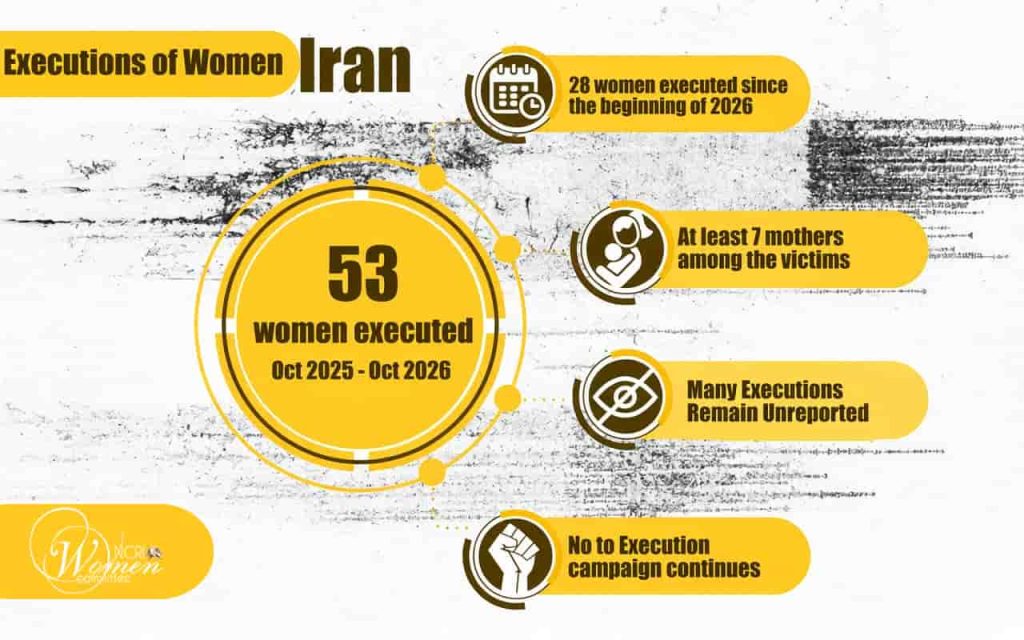
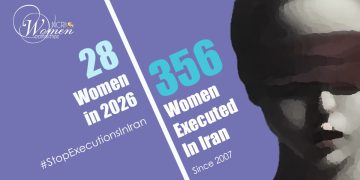
According to information documented by the Women’s Committee of the National Council of Resistance of Iran, at least 28 women have been executed in prisons across Iran since the beginning of 2026. Over a twelve-month period, from October 2025 to October 2026, the number of women executed in Iran reached at least 54. This shocking figure underscores the continued use of the death penalty against women.

These figures have been recorded under circumstances in which, following the nationwide protests of January 2026, months of widespread internet shutdowns, severe communication restrictions, and extensive censorship made the flow of information from inside Iran to the outside world extremely difficult and, in many cases, virtually impossible.

At the same time, a significant number of executions are never officially announced by judicial authorities or state-run media.

On the one hand, the clerical regime has expanded the use of executions in an effort to spread fear, intimidate society, and prevent the growth of popular protests. On the other hand, due to concerns over domestic backlash and international consequences, many of these executions are carried out in secret and without official notification.

For this reason, the available figures should be regarded as only the minimum number of documented and verified executions. The actual number of executions of women in Iran is undoubtedly higher than the cases that have been recorded and published despite censorship, official concealment, and months of communication blackouts.

Executions as a Tool of Repression

In a year when Iran faced a deeply restless society, particularly in the aftermath of the nationwide protests of January 2026, along with mounting political and security crises, execution remained one of the regime’s most important tools of repression.

The rise in executions under such circumstances is not merely a criminal justice policy. It is part of a broader mechanism for spreading fear and silencing social discontent.

The experience of past decades has repeatedly shown that whenever the ruling establishment has faced profound internal crises, it has intensified both the use of the death penalty and broader forms of repression.

Since Masoud Pezeshkian took office, the clerical regime has executed over 4,100 prisoners, including 116 women. From January through October 2026 alone, at least 1,150 prisoners were sent to the gallows in prisons across Iran.

Amnesty International confirmed in its annual report that Iran’s ruling dictatorship carried out at least 2,159 executions in 2025, the highest documented annual execution rate worldwide since 1981.

According to published figures, Iran’s ruling clerical regime carries out the highest number of executions of women in the world.
Executions of Women in Iran in 2026: The Human Cost of State Violence

From Child Marriage to the Gallows

A review of the cases of women executed in 2026 shows that many of them had already been trapped in cycles of discrimination, violence, and injustice long before they reached the gallows. Among them were women who had been forced into marriage as children or teenagers, had endured years of domestic abuse, and had been denied even the most basic legal protections.

For many of these women, the road to the gallows did not begin with the issuance of a death sentence. It began years earlier, when as child brides or victims of violence they were deprived of choice, protection, and justice.

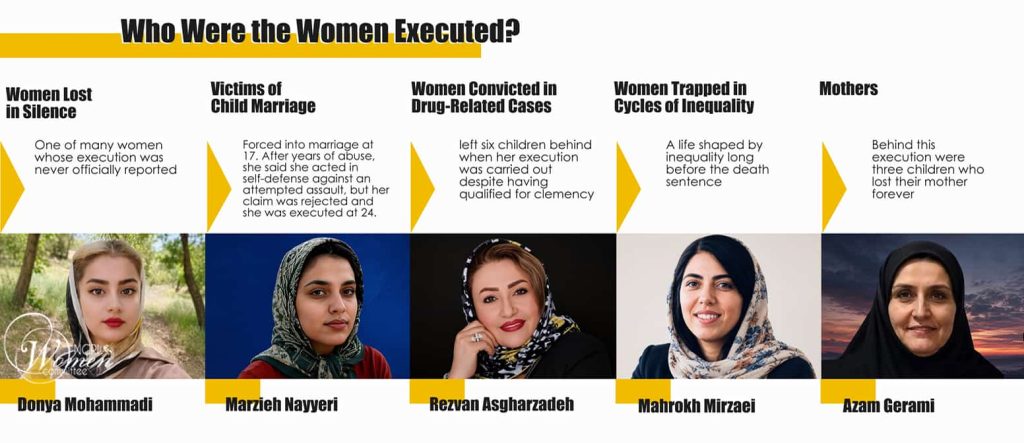
One of the most heartbreaking examples was Marzieh Nayyeri.  At just 17 years old, she was pressured by her family into marrying a man she did not love.

Her husband regularly used drugs and alcohol at home, and Marzieh later testified in court that she had repeatedly been subjected to harassment and abuse by his friends.

When Marzieh was only 18, her husband and one of his associates, after consuming alcohol, attempted to sexually assault her. To defend herself and prevent the assault, she reacted with a kitchen knife, an act that led to her husband’s death.

During her trial, she repeatedly stressed that she had acted solely to protect her life and dignity and that she had been the victim of years of violence and threats. Nevertheless, the court rejected her claim of self-defense, and she was ultimately executed.

Another example was Hanifeh Avandi, who was forced into an arranged marriage at the age of 17 under family pressure and lived for years with the psychological consequences of that experience.

Arezoo Rastad, who was hanged at the age of 23, had likewise been forced as a teenager to marry a man much older than herself and, according to informed sources, had repeatedly endured severe domestic violence.

These cases demonstrate that many women executed in Iran are not only victims of the death penalty itself, but also victims of a system that perpetuates child marriage, forced marriage, violence against women, and the denial of effective judicial protection.

From Poverty and Abuse to the Gallows

Another group of victims among the executions of women in Iran consisted of women convicted in drug-related cases.

However, a closer examination of these cases shows that many of these women lived under conditions of extreme poverty, marginalization, and social vulnerability.

Meanwhile, organized drug-trafficking networks, whose strings are controlled by the IRGC, and which enjoy vast financial resources and influence, continue to operate with impunity.

The cases of Sohaila Azizi, Kimia Khani, Mina Nasirpour, Setayesh Mohammadpour, and Rezvan Asgharzadeh are examples of women whose lives became trapped in a cycle of poverty and deprivation.

Among the cases of 2026, the story of Afsaneh Zandabadi occupies a particularly significant place. Afsaneh Zandabadi was only 22 years old. From childhood, she was subjected to abuse and threats by her stepfather, was denied an education, and, according to her own account, was repeatedly raped. Eventually, that same stepfather forced her into the drug-trafficking trade, and she was ultimately executed. Yet the stepfather faced no legal consequences.

This reality raises a fundamental question: Why are poor and defenseless women sent to the gallows, while the principal actors and beneficiaries of the vast drug trade, many of whom are tied to IRGC networks, are never brought before justice?
Executions of Women in Iran in 2026: The Human Cost of State Violence

Mothers Among the Victims

At least seven of the executed women were mothers.

Tayyebeh Hekmat, Asma Zarei, Setayesh Mohammadpour, Azam Gerami, Mahtab Shirmohammadi, Zahra Azizpour, and Rezvan Asgharzadeh were among the women whose children were left orphaned after their executions were carried out.

In many cases, the human dimensions of this tragedy are especially devastating.

Asma Zarei was a 28-year-old mother who gave birth to her child during imprisonment. At the time of her execution, her child was only two years old.

Setayesh Mohammadpour was executed while her two children, aged eight and eleven, were waiting for their mother to return home. Likewise, Rezvan Asgharzadeh, a 45-year-old mother of six, was executed despite having previously been included on a list of prisoners eligible for clemency before her name was removed.

The execution of a woman is not merely the end of one person’s life; its destructive consequences extend to the next generation as well.

Defying the Gallows from Behind Prison Walls

In the face of the escalating wave of executions, one of the most important expressions of resistance in Iran has emerged from within the prisons themselves and is now in its third year.

The “No to Execution Tuesdays” campaign arose from the very prisons built by the regime to silence dissenting voices. Participating prisoners, among them a significant number of female political prisoners, hold weekly hunger strikes demanding an end to executions and directing their protest at what they see as the regime’s foremost instrument of repression: the death penalty.

Despite pressure, threats, and intimidation, the campaign has not only survived but has steadily expanded.

If execution is the regime’s principal instrument for instilling fear in society, then the “No to Execution Tuesdays” campaign can be regarded as the most enduring and organized protest movement against this policy in recent years, a movement that emerged not in a free environment, but from behind prison walls and from the heart of some of the harshest forms of repression.

Executions of Women in Iran Demand Global Attention

The World Day Against the Death Penalty is an opportunity for the international community to once again focus attention on the executions of women in Iran.

The Women’s Committee of the National Council of Resistance of Iran calls on the United Nations and relevant international bodies, particularly the UN Special Rapporteur on the situation of human rights in Iran, the Special Rapporteur on violence against women, and all organizations dedicated to defending human rights and women’s rights, to take urgent action to prevent the execution of death-row prisoners, especially women prisoners.

Every day of delay costs the lives of dozens of human beings.
Tags: executionViolence against women
ShareTweetPinShareSendShareShare

Related Posts

Iran: 30-Year-Old Woman Mahrokh Mirzaei Executed in Isfahan Prison

October 1, 2026
Iran: 30-Year-Old Woman Mahrokh Mirzaei Executed in Isfahan Prison

On the morning of Monday, September 28, 2026, Mahrokh Mirzaei was executed in Isfahan Prison. She was 30 years old and lived in Isfahan. She had been arrested...

Read moreDetails

Safe Shelter Closures Leave Only 5 Shelters for Women Survivors of Violence in Iran

September 27, 2026
Safe Shelters Closures Leave Only 5 Shelters for Women Survivors of Violence in Iran

Safe Shelters that provide support to women survivors of violence are disappearing across Iran. At a time when rates of violence against women, femicide, and suicide resulting from...

Read moreDetails

Iran: A 46-Year-Old Mother of Three Executed in Isfahan

September 22, 2026
Iran: A 46-Year-Old Mother of Three Executed in Isfahan

Early Sunday morning, September 13, 2026, a female prisoner named Zeynab Rajabi, 46, and a mother of three, was executed at Isfahan Central Prison, also known as Dastgerd...

Read moreDetails

Mother of Six Executed in Iran on Drug-Related Charges

September 17, 2026
Mother of Six Executed in Iran on Drug-Related Charges

Rezvan Asgharzadeh, a 45-year-old mother of six, was executed at Dastgerd Prison in Isfahan on Monday, September 14, 2026. Her execution brings the reported number of women executed...

Read moreDetails

Woman Executed in Mashhad; 25th Woman Hanged in Iran in 2026

September 10, 2026
Woman Executed in Mashhad; 25th Woman Hanged in Iran in 2026

On the morning of Sunday, September 6, the death sentence of a woman was carried out at the Mashhad Central Prison (Vakilabad). The woman executed in Mashhad was...

Read moreDetails

Documents

Sign the Petition: Demand Urgent International Action to Protect Women Prisoners in Iran Iran: Political Prisoner Used as Leverage Against Her Imprisoned Brother

Sign the Petition: Demand Urgent International Action to Protect Women Prisoners in Iran

September 20, 2026

Iran's Women Prisoners: A Human Rights Emergency Demanding Immediate International Action September 2026 To: The UN High Commissioner for Human...

Call for Immediate Action to Halt the Death Sentence of Arghavan Fallahi

Sign our Statement to Halt the Death Sentence of 25-Year-Old Political Prisoner Arghavan Fallahi

July 10, 2026

Statement Calling for Immediate Action to Halt the Death Sentence of 25-Year-Old Political Prisoner Arghavan Fallahi We express our profound...

The Ineffectiveness of Population Policies in Iran: Economy, Aging, and the Overlooked Rights of Women

The Ineffectiveness of Population Policies in Iran: Economy, Aging, and the Overlooked Rights of Women

July 10, 2026

Abstract: A compilation of official data, media reports, and disclosures published in April, May, and June 2026 demonstrates that Iran...

Monthlies

September 2026 Report: The Crisis of Education in Iran Threatens Schoolgirls’ Fundamental Rights and Future
Monthlies

September 2026 Report: The Crisis of Education in Iran Threatens Schoolgirls’ Fundamental Rights and Future

September 30, 2026
August 2026 Report: The Epic of Women Who Said 'No' to the Executioners!
Monthlies

August 2026 Report: The Epic of Women Who Said ‘No’ to the Executioners!

September 1, 2026
July 2026 Report: Death Sentences for Women Rising Up to Overthrow the Mullahs' Regime
Monthlies

July 2026 Report: Death Sentences for Women Rising Up to Overthrow the Mullahs’ Regime

July 31, 2026
June 2026 Report: Working Iranian Women Erased from Labor Market
Monthlies

June 2026 Report: Working Iranian Women Erased from Labor Market

July 5, 2026

Articles

Executions of Women in Iran in 2026: The Human Cost of State Violence

Executions of Women in Iran in 2026: The Human Cost of State Violence

October 8, 2026

Mothers, Child Brides, and Victims; 54 Killed in 12 Months As the World Day Against the Death Penalty is observed,...

Women Teachers in Iran Struggle with Inflation and Low Wages

Women Teachers in Iran Struggle with Inflation and Low Wages

October 4, 2026

Every year, October 5, World Teachers’ Day, provides an opportunity to recognize millions of teachers around the world and to...

Health Crisis and Overcrowding in the Women's Ward of Fardis Prison

Health Crisis and Overcrowding in the Women’s Ward of Fardis Prison

October 2, 2026

Fardis Prison in Karaj, also known as Kachouii Prison or the Fardis Correctional Facility, is in the Hosseinabad area of...

The Fallen for Freedom

Noushin Namvar: A Woman’s Glorious Battle for Liberation
Fallen Trailblazers of Iran’s Freedom

Noushin Namvar: A Woman’s Glorious Battle for Liberation

October 3, 2026
Mojgan Mahdavi: From U.S. Academia to the Frontlines of the Iranian Resistance
Fallen Trailblazers of Iran’s Freedom

Mojgan Mahdavi: From U.S. Academia to the Frontlines of the Iranian Resistance

August 21, 2026
Nasrin Shahrabi: A Lifetime Dedicated to Fighting Religious Fascism in Iran
Fallen Trailblazers of Iran’s Freedom

Nasrin Shahrabi: A Lifetime Dedicated to Fighting Religious Fascism in Iran

August 19, 2026
The Unbroken Smile: How Sara Mokhtar, a Former Airline Executive Became the Vanguard of the Iranian Resistance
Fallen Trailblazers of Iran’s Freedom

The Unbroken Smile: How a Former Airline Executive Became the Vanguard of the Iranian Resistance

June 28, 2026

ABOUT US

NCRI Women Committee

We work extensively with Iranian women outside the country and maintain a permanent contact with women inside Iran. The Women’s Committee is actively involved with many women’s rights organizations and NGO’s and the Iranian diaspora.
The committee is a major source of much of the information received from inside Iran with regards to women. Attending UN Human Rights Council meetings and other international or regional conferences on women’s issues and engaging in a relentless battle against the Iranian regime’s misogyny are part of the activities of members and associates of the committee.

CATEGORIES

  • Activities
  • Articles
  • Documents
  • Fallen Heroes of Iran Uprisings
  • Fallen Trailblazers of Iran’s Freedom
  • Famous Women
  • Heroines in Chain
  • IWD Conferences
  • IWD Speeches
  • IWD Videos
  • Maryam Rajavi
  • Maryam Rajavi Speeches
  • Monthlies
  • Podcast
  • Reference Library
  • Solidarity
  • Statements
  • Videos
  • Women in History
  • Women in Leadership
  • Women of Iranian Resistance
  • Women's News

BROWSE BY TAG

Child marriage coronavirus education execution forced hijab Gender Gap Generation Equality Honor killings Iran Teachers Maryam Akbari Monfared Nurses Plan on Women's Rights and Freedoms Poverty Prisoners Protests rural women Saba Kord Afshari The girl child Violence against women Women's Leadership Women Heads of Household Zeinab Jalalian

The copyright of all the material published on this website has been registered under © 2016 the Women’s Committee of the National Council of Resistance of Iran. To obtain permission to copy, redistribute or publish the material published on this website, you should write to the NCRI Women’s Committee. Please include the link of the original article on our website, https://wncri.org

Welcome Back!

Login to your account below

Forgotten Password?

Retrieve your password

Please enter your username or email address to reset your password.

Log In

Add New Playlist

No Result
View All Result
  • Home
  • News
    • Women’s News
    • Articles
    • Statements
  • Publications
    • Monthlies
    • Documents
    • Reference Library
  • About Us
    • The NCRI Women’s Committee
    • Gender Equality
    • Women’s Platform
  • Maryam Rajavi
    • Maryam Rajavi
    • Maryam Rajavi Speeches
    • Ten Point Plan for Iran
    • The Plan on Women’s Rights and Freedoms
  • Vanguards
    • Fallen Trailblazers of Iran’s Freedom
    • Fallen Heroes of Iran Uprisings
    • Heroines in Chain
    • Women of Iranian Resistance
    • Famous Women
    • Women in History
  • Events
    • IWD Conferences
    • Activities
    • IWD Speeches
    • Solidarity
  • Video
    • Videos
    • IWD Videos
  • Podcast
  • DONATE
  • Contact us
  • فارسی
  • عربی
  • Français

The copyright of all the material published on this website has been registered under © 2016 the Women’s Committee of the National Council of Resistance of Iran. To obtain permission to copy, redistribute or publish the material published on this website, you should write to the NCRI Women’s Committee. Please include the link of the original article on our website, https://wncri.org