
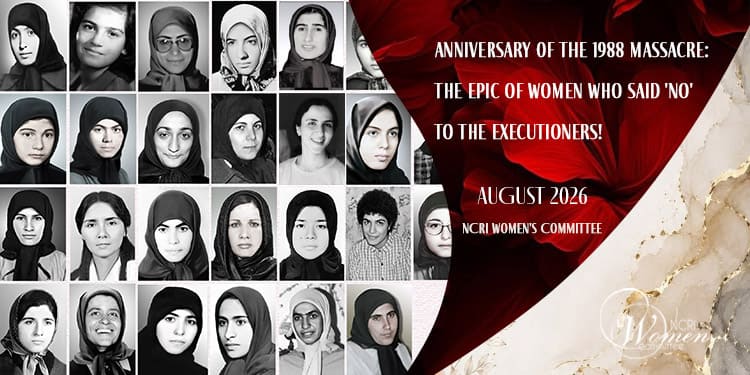
Anniversary of the 1988 Massacre: The Epic of Women Who Said ‘No’ to the Executioners!
The August 2026 report is dedicated to the anniversary of the 1988 massacre, focusing on the women executed during this tragedy. Its purpose is to review one of the most significant events in contemporary Iranian history from the perspective of female political prisoners, the human toll of this disaster, and the imperative for justice.
In this report, we have sought to present a coherent picture of the historical background, the sequence of events, the resistance of women, and the continuation of the movement for justice.
Why Must We Still Speak of the 1988 Massacre?
The summer 1988 massacre is not merely a historical event in the collective memory of the Iranian people. Due to its vast dimensions, systematic cover-ups, and the lack of accountability, it remains an active topic in the realm of human rights and justice seeking in Iran.
Among the 30,000 victims of this massacre, women hold a unique position—women who had endured years of imprisonment yet steadfastly refused to surrender their beliefs.
The overwhelming majority of the 1988 massacre victims were members and supporters of the People’s Mojahedin Organization of Iran (PMOI/MEK). However, in later stages, the execution decree was expanded to encompass resistant, militant prisoners from other political groups as well.
Prisoners were hanged in groups of 10 to 15, after which their bodies were hauled out of the prisons in dump trucks and buried in unmarked mass graves. No mercy was shown, not even to teenage girls or pregnant women.
Ayatollah Hossein-Ali Montazeri, the designated successor to regime founder Ruhollah Khomeini at the time, revealed in his memoirs published in December 2000 that young girls and women were subjected to horrific torture prior to execution during the 1988 massacre.
Historical Background
During the 1980s, a vast number of members and supporters of the People’s Mojahedin Organization of Iran (PMOI/MEK) were arrested and imprisoned. The summer of 1988 marked the bloody climax of a campaign of repression that resulted in their mass execution. This was an organized crime against defenseless, bound political prisoners, many of whom had already completed their court-issued prison sentences.
The massacre of over 30,000 political prisoners in the summer of 1988 is documented as the greatest crime against humanity since World War II and the most hideous genocide in modern Iranian history. This horrific tragedy can be described as the “largest unpunished crime against humanity.” Through his execution fatwa, Khomeini sought to eradicate the strongest, most popular active political organization and democratic alternative to his regime to guarantee the survival of his clerical dictatorship.
Over 90 percent of those executed were members and supporters of the PMOI, the majority of whom were arrested as high school and university students in 1981 and had already served out their unlawful prison terms.
Chronology of Events
- Beginning of a new wave of repression and preparations for mass executions
July 1988
- Formation and operations of the Death Commissions; initiation of mass political prisoner executions
July 19, 1988
- Continuation of mass executions across prisons nationwide
August & September 1988
- Complete blackout imposed on families; systematic concealment of victims’ burial sites
Post-Executions
- Persistent campaigning for justice by victims’ families, survivors, and international human rights organizations
Subsequent Years
- Unrelenting international demands for independent investigations and accountability for perpetrators
Present Era
The Epic of Resistance and Steadfastness of Women
One of the dimensions requiring serious examination regarding the 1988 massacre of political prisoners is the execution of thousands of women during this genocide. Many of them were arrested in their adolescence, endured years of imprisonment, and were subsequently executed during the massacre. Highlighting this aspect demonstrates that the crackdown on them was not merely a reaction to past activities, but a deliberate attempt to extinguish an ideology and an ideal.
Assessing the conduct of the clerical regime’s executioners toward captive political women is, on the one hand, deeply painful, and on the other, illustrative of an epic and remarkable resistance.
According to eyewitness accounts, in three women’s wards of Evin Prison, 80 percent of the prisoners were hanged or shot by firing squad by September 1988. The prosecutor in the Stockholm trial of Hamid Noury, one of the perpetrators of the massacre, explicitly explained: “Women were executed in the first wave, and in our investigation, we were unable to find women who survived the executions in the women’s ward.”
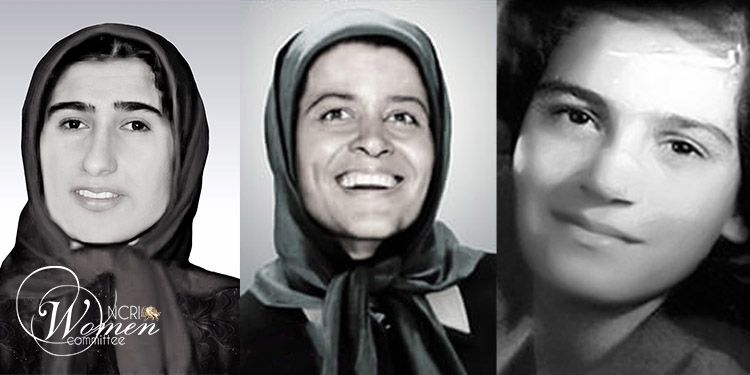
The victims spanned a broad spectrum of professions and social backgrounds. Female political prisoners executed during the 1988 massacre included parliamentary candidates such as Fatemeh Zare’i from Shiraz and Zohreh Eyn-ol-Yaqin from Isfahan; medical professionals Dr. Hamideh Sayyahi and Dr. Shourangiz Karimian; Forouzan Abdi, a member of the Iranian National Women’s Volleyball Team; and Ashraf Ahmadi, a mother of four and former political prisoner during the Shah’s regime.
These female political prisoners were conscious, steadfast activists who refused to compromise on their ideals despite enduring unimaginable brutality and pressure. The unwavering resilience of these women has transformed their memory from a mere historical footnote into a living symbol of resistance against tyranny. They stand as an enduring reminder of the heavy price paid by previous generations for freedom, democracy, and human dignity.

Monireh Rajavi: Symbol of Massacred Political Prisoners
The name Monireh Rajavi, as a symbol of the massacred political prisoners, is inextricably bound to steadfastness, sacrifice, and loyalty to the ideal of freedom. Her iconic legacy is not limited to an individual life; rather, it reflects the fate of thousands of other prisoners who lost their lives during the 1980s.
Honoring the memory of Monireh Rajavi also offers an opportunity to reexamine the vanguard role of women in the resistance movement and serves as a reminder that a major portion of Iran’s historical memory of justice-seeking has been built upon the sacrifices of women who paid the ultimate price.
At the time of her arrest, Monireh Rajavi’s only “crime” was being the sister of Massoud Rajavi, the Leader of the Iranian Resistance. Her young daughters, Maryam and Marjan, along with her husband, were also arrested at the same time. She spent the final seven years of her life in the torture chambers and dungeons of the clerical regime.
Monireh’s two young daughters witnessed her severe torture, as well as the torture of other prisoners, over a period of many months.
One day, when one of Monireh’s cellmates was taken for interrogation, she saw two fair-haired young girls standing outside the torture chamber of Branch 7 in the Evin interrogator’s office. These children were Monireh’s daughters, forced to watch the brutal tortures inflicted upon their mother while the guards repeatedly beat them as well.
The surviving prisoner recalled: “I quietly asked the woman with the girls for her name. She said, ‘My name is Monireh Rajavi, and my only crime is being Massoud’s sister.'” Despite being subjected to continuous humiliation and beatings, the regime failed to break her spirit.
During one roll call, an interrogator approached Monireh, kicked her, and declared: “I will never let you leave this prison alive to become a hero for your brother.”
Monireh was renowned among prisoners for her unwavering solidarity and support. Whenever prisoners returned from interrogation rooms, Monireh was the first to rush to care for the tortured women. Addressing this brutal environment, she once said: “They want to destroy our human identity. But that is precisely why we must fight back. The way to wage this fight is by caring for one another as much as we can.” She exemplified this principle in her daily actions.
Despite having committed no crime, she was sent to the gallows during the 1988 massacre, five years after completing her original prison sentence. Mullah Hossein-Ali Nayeri, the religious judge at Evin Prison, personally oversaw the execution of Monireh Rajavi, insisting that her hanging be expedited. Monireh was 38 years old at the time of her martyrdom.
Narratives and Testimonies
In an audio recording released from an August 1988 meeting between Hossein-Ali Montazeri—then-designated successor to Khomeini—and members of the Death Commission, it was revealed that 300 PMOI/MEK women and young girls were executed en masse. Among them were two French nationals who were spared no mercy.
The recording also mentions the execution of a 15-year-old girl who was arrested solely to exert pressure on her resistant brother; when she refused to condemn him, she was sent to the gallows. Furthermore, the summary execution of a pregnant woman in Isfahan was acknowledged.
Firsthand witness reports and documented testimonies regarding the “death halls” form a crucial part of the historical memory surrounding this genocide. These accounts remain vital for recording the truth in the annals of history and preventing systematic denial and distortion. The testimonies of survivors and victims’ families offer a profoundly human portrait of suffering, hope, and unwavering resistance.
Nahid Afshar: Nahid was a 12-year-old schoolgirl who was arrested by Revolutionary Guard Corps (IRGC) guards on September 27, 1981, and thrown into prison.
Batool Majani, a survivor and witness of the 1988 massacre, recounted young Nahid’s tragic story: “Nahid told me, ‘I was arrested alongside two of my 14-year-old friends. They executed both of them and kept me in detention. They repeatedly beat and tortured me. Once, while being tortured, I cried out that my heart hurt so they would stop hitting me. The interrogator maliciously asked: “Which side is your heart on?” I said: “The right side!” The interrogator insolently replied: “Now I’m going to beat you so hard your heart will actually hurt, and you’ll learn which side it’s on.”‘
Interrogators subjected Nahid to intense physical and psychological pressure to break her spirit. According to her own account, they even took her to the house of an IRGC guard for nine months to break her resolve. Yet, she returned to the prison wards steadfast, courageously defending her identity and stance as a member of the PMOI.
She was detained in Lower Ward 246 of Evin Prison, a ward with one room specifically reserved for broken prisoners and traitors, where the authorities used every possible tactic to crush her spirit. Yet, whenever the opportunity arose, she immediately sought out the rooms of the steadfast political prisoners.
Nahid Afshar used to say, “No matter how much pressure these interrogators put on me, Brother Massoud (Rajavi) remains in my heart; I can never tear him out.”
She was initially sentenced to death, but she remained resolute as she grew up behind bars. After some time, her sentence was reduced to 15 years in prison. Nevertheless, during the 1988 massacre, Nahid Afshar was sent to the gallows under the fatwa of the anti-human Khomeini and his Death Commission.
Sakineh Delfi: A 26-year-old heroic lionheart from Abadan. Her final arrest took place in April 1987. To escalate the pressure on her, authorities transferred her between three different prisons to force her submission, but Sakineh mocked both torture and pain. Ultimately, she was transferred to Fajr Karoon Prison in Ahvaz, where brutal tortures intensified.
She was burned with a hot iron, her fingernails were pulled out, metal rods were thrust into her body alongside severe flogging, she was repeatedly hung by her hair, her knees were drilled into, and she was thrown into ice water during the dead of winter. Yet, she refused to yield or speak.
In the prison of Ahvaz, when the executioner mullahs (Jazayeri and Abdollahi) shouted, “You must state your position—Khomeini on one side, and Massoud Rajavi on the other!” she roared from the back of the ward: “Long live Massoud, death to Khomeini!” IRGC guards set upon her immediately, leaving her severely wounded. The following day, out of that 350-person ward, 349 political prisoners were hanged.
The pure body of Sakineh Delfi and her fellow PMOI freedom fighters, who were among the first group executed by firing squad during the massacres in Ahvaz, were buried behind the Ahvaz Steel Complex. The regime poured 30 centimeters of lime and cement over their mass graves in a desperate attempt to permanently conceal their crime against humanity.

Masoumeh and Mehri Karimian: Dr. Masoumeh Karimian, known among her comrades as Shourangiz, was a physiotherapist educated in the United Kingdom. Following her arrest in 1981, she was immediately subjected to brutal torture by IRGC guards. Interrogators harbored intense malice toward her due to her unyielding spirit; whenever they sought to punish a group of prisoners, Shourangiz was invariably among them. Serving as an orthopedic doctor, she secretly treated many prisoners suffering from physical injuries caused by torture, utilizing the scarce resources available within the prison.
From 1983 to 1984, Shourangiz was confined in the solitary “cages” of Unit 1 in Ghezel Hesar Prison. Due to severe, relentless torture, she was unable to walk properly and limped permanently. She never removed her socks because her feet were so severely mangled that she refused to let others see her injuries. Ultimately, after seven years of steadfast resistance, this selfless and uncompromising physician was executed by firing squad in Evin Prison on July 30, 1988, during the first wave of executions, alongside her sister Mehri, a university student.
Razieh Ayatollahzadeh Shirazi: Razieh held a bachelor’s degree in physics from the University of Tehran. A daring, spirited, and vibrant woman, she became acquainted with the PMOI in 1978 at the age of 24. She was always the first to volunteer for difficult assignments. Despite her small and slender stature, nothing could deter her from fulfilling her responsibilities.
She was arrested during the peaceful demonstration on June 20, 1981, while two months pregnant, and was subjected to severe torture in Evin and Gohardasht prisons until 1988. Throughout her pregnancy, she was incarcerated in a freezing, windowless solitary cell, which led to a chronic kidney condition. When she went into labor, authorities delayed her transfer before taking her to an outside hospital. She recounted hearing her newborn daughter cry, but IRGC guards callously informed her that the baby had died.
Razieh constantly sought creative and innovative ways to support her fellow prisoners, who revered her as an icon of resistance and resilience. On September 25, 1988, she was hanged from a crane in front of her fellow inmates.
Maliheh Aghevami: Maliheh was a high school student from Shahroud who joined the PMOI immediately following the 1979 anti-monarchical revolution. A cheerful, passionate, and vibrant girl with the sweet wit of youth, she was arrested prior to June 20, 1981.
Following the onset of the massacre in August 1988, Maliheh was summoned before the “Death Commission.” No one knows what transpired during her interrogation, but the sole surviving document written in her own hand sheds light on her final moments. Her handwritten note reads:
“August 4, 1988 — I, Maliheh Aghvami, was taken to court at 3:00 PM and received my death sentence. It is now 7:00 PM, and I am being taken for execution.”
Authorities refused to return Maliheh’s body to her family. Sometime later that same year, a very young Bassij paramilitary member arrived at her mother’s house with a box of sweets and 500 tomans, declaring: “I was your son-in-law; this is your daughter’s dowry.”
Human and Social Consequences
The 1988 massacre left profound, enduring scars on families and Iranian society. For decades, thousands of families have lived in a state of agonizing uncertainty, loss, and unanswered questions, with many remaining deliberately deprived of information regarding the burial sites of their loved ones. Beyond the severe psychological and social trauma inflicted, this reality underscores the critical urgency of uncovering the truth and achieving justice.
Maryam Akbari Monfared, a prominent female political prisoner, served 17 consecutive years in prison without a single day of leave solely for demanding justice for her sister and brother executed during the 1988 massacre, as well as two other brothers executed during the 1980s. In an open letter addressed to former regime prosecutor Mullah Mousavi Tabrizi regarding the persecuted families of the massacred PMOI martyrs, she wrote:
“Perhaps you have forgotten but let me remind you: families were denied even the right to hold memorial services. When families gathered in private mourning, your forces raided their homes, arrested them alongside all their guests, and dragged them to prison. You never returned the bodies of their loved ones, never disclosed where they were buried, and provided not even a trace of a grave!”

Khavaran Cemetery, located on a barren plot of land outside Tehran, serves as one of the largest mass burial sites for thousands of PMOI freedom fighters and dissidents massacred in the summer of 1988.
Decades later, countess mothers, wives, and sisters of these martyrs remain deliberately deprived of the exact locations of their loved ones’ graves, holding only the tragic assumption that they rest beneath these grounds. Similar secret mass graves exist in numerous cities across Iran where victims of the 1988 genocide were secretly buried.
Every year, on the anniversary of the massacre and ahead of the Persian New Year (Nowruz), families gather at these sites to honor the memory of their martyrs, showering the soil with flowers in place of marked graves. In recent years, however, the clerical regime has routinely locked the gates of Khavaran Cemetery, barring grieving families from visiting even these unmarked, symbolic grounds.
This year, on Friday, August 28, 2026, marking the 38th anniversary of the massacre of PMOI and dissident political prisoners, a group of justice-seeking families of the executed political prisoners gathered at Khavaran Cemetery to honor the memory of their loved ones. Security agents locked the gates to prevent the families from entering and standing at the burial sites of their relatives. Unable to enter, the seeking families placed portraits of their executed loved ones behind the locked gates, showered their pictures with flowers, and paid tribute to their memory by singing revolutionary songs.
The regime has repeatedly blocked victims’ families from entering Khavaran Cemetery in past years. Regime officials have even systematically destroyed mass graves of 1988 massacre victims across various cities. To further conceal the fate and burial sites of the victims, authorities have consistently refused to issue death certificates and have actively erased the names of the executed from official deceased registries.
In 2021, the regime undertook the destruction of the Khavaran burial site and began forcibly burying deceased members of religious minorities there. In 2017, the graves of martyrs in Behesht-e Reza in Mashhad and Wadi-e Rahmat in Tabriz were systematically demolished. In August 2018, the regime destroyed the mass graves of the 1988 massacre victims in Ahvaz under the pretext of constructing a boulevard. Regime authorities have gone so far as to turn some of these mass grave sites into refuse dumps.
Justice and the Imperative for Accountability
UN experts have repeatedly emphasized the urgent need for independent investigations and international discourse surrounding these crimes against humanity and acts of genocide.
Geoffrey Robertson, a prominent human rights lawyer, King’s Counsel, and former judge on the UN Special Court for Sierra Leone, characterized the 1988 massacre of political prisoners in Iran as the worst crime against humanity committed since World War II.
On December 9, 2020, the United Nations made public an official letter authored by seven UN human rights experts demanding full accountability from the Iranian regime regarding the 1988 massacres in Iran.
In a September 3, 2020, letter addressed to the Iranian regime, UN human rights experts expressed grave concern over the ongoing refusal of Iranian authorities to disclose the fate and whereabouts of thousands of individuals who were forcibly disappeared and extrajudicially executed in 1988.
Finally, following years of persistent efforts by the Iranian Resistance and the Call for Justice Movement, Professor Javaid Rehman, the UN Special Rapporteur on the situation of human rights in Iran, released a landmark report on July 22, 2024. He formally declared:
“The summary, arbitrary and extrajudicial executions during the 1980s and the 1988 massacre amount to crimes against humanity (including murder and extermination), genocide, and atrocity crimes. Crimes against humanity also encompass torture, imprisonment, and enforced disappearances, with the continuation of these crimes driven by the persistent impunity enjoyed by perpetrators who remain at the highest levels of power.”
He noted that the majority of the executions targeted the People’s Mojahedin Organization of Iran (PMOI/MEK) and individuals who remained steadfast in their positions.
The Special Rapporteur called for the establishment of an independent international mechanism to ensure comprehensive investigations and accountability for serious crimes, including crimes against humanity, genocide, and sexual violence. The objective of this mechanism is to collect and preserve evidence for future prosecutions and to address atrocities committed against political dissidents, religious minorities, and women and girls in Iran.
Professor Rehman also urged individual UN Member States to “use universal jurisdiction to investigate, issue arrest warrants for, and prosecute individuals for atrocity crimes committed during the 1980s, including in 1981–1982 and in 1988, which amount to crimes against humanity and genocide, as well as other serious human rights violations amounting to crimes under international law, including torture, enforced disappearance, and arbitrary and extrajudicial executions.” (Chapter VII. Conclusions and Recommendations, page 62, paragraph m)

Conclusion
The saga of women’s heroism in the 1988 massacre remains one of the most enduring chapters in the contemporary history of Iran. Through their steadfast resistance, these women demonstrated that relentless repression can never quench the ideal of freedom. The name of Monireh Rajavi and the other women who perished in the hot summer of 1988 serve as a reminder that the historical memory of nations is forged by those who refuse to surrender their beliefs, even under the most arduous conditions.
Paying tribute to their memory, the Women’s Committee of the National Council of Resistance of Iran (NCRI) underscores the imperative of seeking justice, establishing the truth, and holding accountable the perpetrators and masterminds of this genocide and major crime against humanity.