
Prison Memoirs of Azam Haj-Heydari from the book The Price of Being Human— Part Eighteen
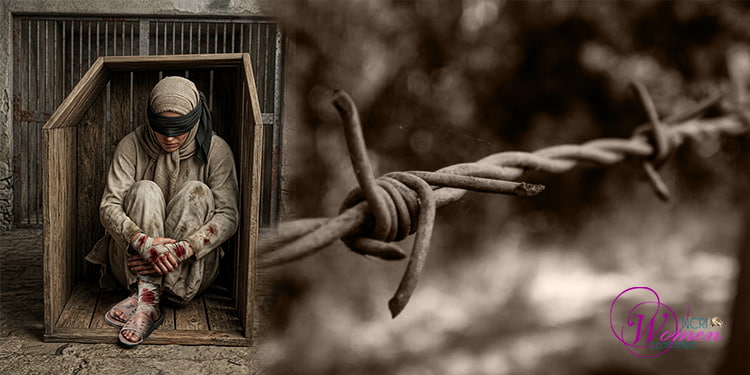
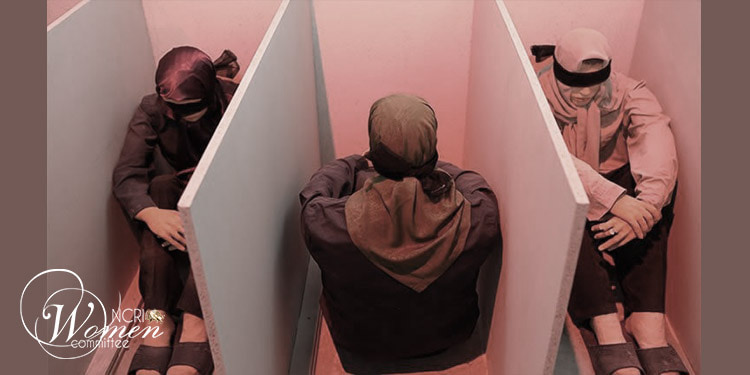
In this installment of Azam Haj Heydari’s prison memoirs, published in The Price of Being Human, she recounts her experiences during the seven and a half months she spent blindfolded in the Cage Ward. She describes the smallest details of how she endured this form of torture and the methods she devised to resist it, preserve her mental strength, and keep herself from being broken.
At the time, Azam was a young teacher of 22 or 23 who had embarked on the path of resistance. She spent five years in the Judiciary’s Temporary Detention Center, Evin, and Gohardasht Prison, where she was subjected to brutal torture by Khomeini’s Revolutionary Guards.
Seven and a Half Months Blindfolded in the Cage Ward
In the first few days, I still did not know how long I might remain there, what I should do, or what kind of routine I should establish for myself. It really was a new world, whose rules I did not yet understand. How was I supposed to get through the days and nights?
I was still in the initial phase, and I had not yet fully felt the pain of being alone, the emptiness left by the absence of the other girls, or the collective life we had shared. I kept track of the days of the week and was aware of the hours of the day and night.
From morning onward, I would mentally carry out the same routines we had followed in the ward and talk to the girls in my mind. I would go over the days we had spent together, and thinking of them and remembering them kept me cheerful and energized. I did not yet think much about what I was going to do in the long term.
But after five or six days, the silence began to weigh on me, and I could no longer go on simply by revisiting the past. In particular, I was gradually reaching the conclusion that this was not going to last for a few days or a few weeks. I was beginning to understand that Haji’s threats were serious: either we would break down there and surrender, or this situation could continue indefinitely, perhaps for years.
So, I began thinking about what I should do and how I could fill these endless days and hours.
When a person is alone, blindfolded, and surrounded by silence, she becomes a hunter of sounds. She catches and analyzes every little noise, every word, even the sound of someone breathing, and draws conclusions from them.
Haji has just come in. Someone else is with him, his deputy, Ahmad. Now he is talking to that filthy collaborator, who is reporting to Haji. In a few minutes I will hear the sound of one of the girls’ heads being smashed against the wall. What if it is me? Or, that was the sound of a cooking pot. It must be lunchtime. That big, clumsy guard is bringing the food. I recognize him by the way he drags his feet across the floor…
I think the collaborators who were watching us knew this too and had probably been instructed to whisper among themselves to make the prisoners curious and hypersensitive to what they were saying.
Sometimes they tried to use this method to plant ideas in our minds. For example, they would whisper loudly enough that I could barely hear them: “Azam has gotten herself into all this trouble because of that Mansoureh, while Mansoureh has told them everything and is now walking around freely” and so on.
Sitting crouched for hours in silence, blindfolded and lost in thought, carries the danger of turning a person inward until she becomes completely immersed in her own illusions and fantasies. A person can become mentally unstable. That was precisely why they had built these cages. I was terrified of losing my mind just as much as I was of breaking.
But I concluded that I could not allow the sinister plans of Khomeini, his executioner Lajevardi, and his accomplice Haji Rahmani to succeed.
No! Never!
So, I had to prepare myself for a long period. I had to remain on alert and not allow lethargy to overcome me. I therefore made a schedule for myself.
I began each morning with wake-up, prayer, and morning assembly. I would say, “In the name of God and in the name of the heroic people of Iran,” and…
I would recite the morning assembly text, mentally standing rigidly at attention before the Organization’s emblem and the Iranian flag, and sing revolutionary songs. Every day I chose three songs and sang them. Then I would say: “Salute to the martyrs of the struggle for freedom! Salute to the proud People’s Mojahedin Organization of Iran!”
I had also added some sentences of my own to the morning assembly:
“Salute to the steadfast prisoners who chose the suffering of torture over the disgrace of betrayal! Salute! Salute! Salute!”
After the morning assembly, I would sing songs. Every day I sang three songs that I knew by heart, both so that I would not forget them and so that I would not retreat into myself. Sometimes I had forgotten certain parts. I would repeat them over and over with the help of the melody and tune I remembered until the words came back to me. When I managed to recall passages and sentences that I had never thought I would be able to remember, I was delighted, as though I had found something precious, and it gave me confidence in myself.
I had planned what I would read at each hour and even what I would think about. I realized that I was learning how to use my mind and retrieve and revive things that were stored there but that I had forgotten.
I remembered that during my political activities before June 20, 1981, I had owned a songbook called Kuhestan [The Mountain Region]. I had memorized most of its poems and songs, but because I had not read them for several years, I had forgotten them. I decided that, to keep my mind active, I would try to recall those very poems that I did not think were still somewhere in my memory.
My mind had become active. I was remembering many things. I would put the lines and verses I recalled together like pieces of a puzzle until they gradually became complete, or almost complete. For the parts I could not remember, I would think and create substitutes for them. I enjoyed this immensely. I felt lively and would forget the circumstances in which I was living.
Then I would think about books I had read—books that at the time I had not fully understood or had failed to remember. I would make agreements with myself: I must remember such-and-such a subject from the history book. I must remember which book I read this particular subject in. What other subjects was it connected to?
This kind of thinking taught me discipline and how to control my mind, and it saved me from boredom and withdrawing into myself. More importantly, I was discovering that I had a great deal stored in my mind, but it had become clouded and scattered. Gradually I was learning how to find those things, organize them, brush away the dust of forgetfulness, and put them back where they belonged.
It was like discovering a new country, and it was exhilarating.
I had also set aside half an hour in my schedule to recite passages from the Qur’an and the Nahj al-Balagha that I had memorized. In prison, the only books they gave us to read were the Qur’an, the Nahj al-Balagha, and religious books—mostly garbage such as books by Dastgheyb, Beheshti, Motahari, and others like them (who were approved by the regime). But I only read the Qur’an and the Nahj al-Balagha. I memorized them and had absolutely no desire to look at that other garbage.
Now I was so glad that I had done so.
In the ward, the girls and I had a program of memorizing Qur’anic chapters and verses and sermons from the Nahj al-Balagha. We had memorized all of the thirtieth juz’ and part of the twenty-ninth, as well as a number of sermons. At the time, we had done this because we might be taken to solitary confinement and would need something to occupy our minds. Now everything I had memorized back then had become a resource for me. I would review it and think about it.
I recited these passages every day so that they would remain fresh in my mind and also as a form of mental exercise. Then I would choose one verse and think about it.
In the previous wards, one of our possessions had also been a book called A Ray of the Qur’an—Ayatollah Taleghani’s commentary on the Qur’an. We had secretly kept a copy with the older women prisoners and taken turns reading it. Now that I was in the Cage Ward, under conditions far worse than before, what I had learned from that book was also part of what I possessed.
Sometimes even a single sentence from it that I remembered would become the subject of my thoughts and reflections for a long time.

Among the things I had forced myself to retrieve from my memory were prayers that I had once recited together with Ashraf Ahmadi, who was killed by the regime. They were prayers from the Sahifa, which I gradually managed to remember. By then, I had remembered so many of them that reading them from beginning to end took an hour and a half.
I especially loved the Ziyarat Ashura and Ziyarat Warith, because every sentence drew clear lines of distinction, and I drew inspiration and motivation from them about how to stand firm. When I recited them, I felt as though I were as hard and steadfast as a mountain.
Sometimes I would remember how frightened I had been at the beginning of my arrest and realize how much I had grown. My world had changed, and the arena of struggle had become open and clear to me.
It was as though during this period I had come to know Khomeini and his reactionary ideology through what amounted to decades of study and reading. My hatred of them had grown to the size of a world, and nothing could stop me from continuing the struggle and fighting against them.
The more I thought, the more new things I understood—things I had not understood before and could not have understood before.
In particular, I came to deeply understand what it means to say that the Qur’an and its verses can only truly be understood through action and through lived experience in the struggle.
For example, when I read the Qur’anic verse, “Indeed, with hardship comes ease,”[1] at first, I understood it to mean that ease comes after hardship. Put simply, this too shall pass. Or, as the saying goes, the end of the dark night is dawn.
But when I thought about this verse, I suddenly realized: Look! It does not say, “After hardship comes ease.” It says, “Indeed, with hardship comes ease,” and then repeats it: “Indeed, with hardship comes ease.”
That means that with the hardship itself, within the hardship itself, there is ease!
That is, precisely when you think things have become unbearable and you have reached the end of your endurance, if you persevere, if you do not become afraid and surrender, if you struggle to find a way out of the hardship, you will undoubtedly reach relief, opening, ease.
The only condition is that you must not become heedless and must be prepared to endure every hardship. In other words, you must not become weary, saddened, or hopeless because of the difficulties along the way. You must not lose your spirit or, as we used to say, “complain.”
Blessed be the memory of Masoumeh, who taught me: “A Mojahed does not complain.”
I had experienced this to some extent in the cell, during interrogation, and under torture. Then I remembered that even in the ward—the so-called punishment ward—we were constantly experiencing the same thing.
The executioners had thrown us into that ward and increased the pressure every day, trying by any means to break us and drive us to give up. But by resisting the enemy, we gained strength and became filled with energy. We had moved from usr—hardship—to yusr—ease and relief.
Now I knew that in this very cage, under these very conditions that had been created to crush and destroy us, if I resisted, if I defeated the executioners’ efforts, and if I remained patient and steadfast in the trials that had befallen me on the path of struggle, I too would reach yusr.
And so, I began trying to understand and discover the rules governing this new world.
To be continued…
[1] Qur’an 94:5–6, traditionally translated as “Indeed, with hardship comes ease.”