
Low Female Participation as Part of a Policy of Suppression
Gender Gap in Iran: Iranian women, under a religious dictatorship, are deprived of even the minimum rights required for a dignified and just life. The deep gender gap is itself a consequence of this very policy.
The structure of power and the labor market in Iran is patriarchal. Employment policies are based on the assumption that men are the breadwinners, while women are expected to take care of household duties and childrearing. Hiring quotas, banking facilities, and even welfare policies are designed in a way that prioritizes men and pushes women to the margins. Labor and family laws effectively do not support women’s economic independence, and women’s employment is contingent upon their husband’s permission.
Reports published in the media and by international bodies such as the World Bank and the World Economic Forum are based on official government data. Since the clerical regime lacks transparency in publishing statistics and manipulates data to serve its political interests, these reports cannot fully reflect the reality in Iran. Nevertheless, even these assessments point to a massive gender gap in the country.
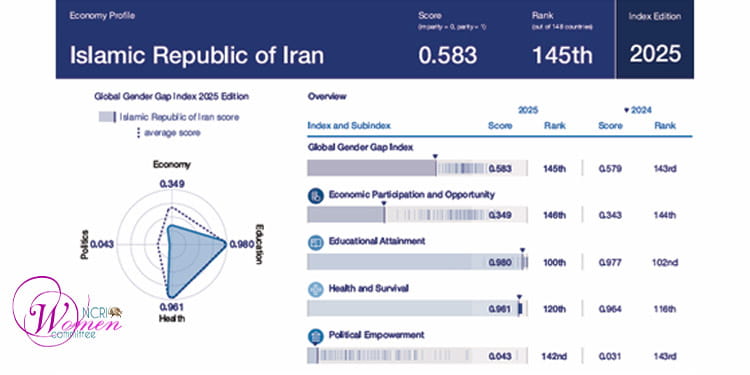
World Economic Forum Report 2025:
Among 148 countries worldwide, the Islamic Republic of Iran ranks 145th in terms of gender inequalities and the effectiveness of national policies aimed at promoting gender equality.
Iran’s overall Gender Gap Index score is 0.583. The score for education is 0.977, health and survival stand at 0.964, political participation is 0.031, and economic participation is 0.343.
Women’s employment in Iran is lower than in both Pakistan and Saudi Arabia. In global comparison, Iran’s position in the economic equality sub-index is better only than Bangladesh and Sudan; however, in the labor force participation rate, Iran ranks dead last, with women’s participation at just 20.1 percent.
(Rouydad 24, 8 March 2025)
The clerical regime’s propaganda about the widespread appointment of women managers relies on statistical manipulation and the placement of women in positions such as deputies, advisors, and similar roles—positions that lack real authority or the power to effect change. On March 11, 2024, the news website Khabar Online, quoting a sociologist, wrote: “The government has even counted ‘female principals of girls’ schools’ as part of the statistics on women’s participation in management.”
Katayoun Mesri stated on the social media platform Clubhouse: “The Vice Presidency for Women’s Affairs has announced that ‘25 percent’ of the country’s managers are women, but it has not provided any ‘classification of the levels of female deputy managers.’ Based on my own estimates from social networks (as access to transparent statistical sources is difficult), only 6 percent of members of parliament, 3 percent of senior and mid-level managers, 1.5 percent of members of city and village councils nationwide, and 12 percent of members of metropolitan city councils are women. In large private-sector organizations and holding companies as well, ‘women’s roles do not go beyond that of a passive member of the board of directors.’”
The sociologist emphasized: “The system is fundamentally based on inequality between women and men; it views women as belonging to the private sphere and men to the public sphere, and believes that for women, the roles of wifehood and motherhood are the most important. Within this discourse, gender boundaries—even when women enter the public sphere—assign them jobs and roles that closely resemble motherhood and wifehood, such as teaching, nursing, childcare, and the like. Thus, power and the public sphere remain firmly in the grip of a male symbolic order that does not allow women to enter it.”
With this background in mind, we now turn to a more detailed examination of women’s participation across different indices.

Political Participation
The power pyramid of the religious dictatorship is structured so that its uppermost levels are entirely male and devoted to enforcing repressive and misogynistic policies. At the apex stands the leader of the system, the primary decision-maker, who is a cleric holding this position for life. The regime’s brutal military force, the Islamic Revolutionary Guard Corps (IRGC), operates under Khamenei’s direct command and is responsible for preserving the rule of the velayat-e faqih. Today, it also dominates much of the country’s economic and development sectors.
Below the Supreme Leader sits the entirely male Expediency Discernment Council, whose members are individually appointed by Khamenei and effectively serve as his think tank.
Alongside the Expediency Council is the Guardian Council. This body is tasked with safeguarding fundamentalism and the clerical regime’s backward interpretation of Islamic law within legislation and state policy. Its members are also entirely male and predominantly clerics.
Beneath these layers are the government and the three branches of power: the legislative, executive, and judiciary. The regime’s constitution defines both the presidency and the judiciary as male positions, effectively barring women from leading these institutions. Likewise, throughout the 47-year lifespan of this system, the regime’s parliament has never had a female speaker, nor does its composition or nature suggest such a possibility.
In the current cabinet, there is only one female minister, serving as Minister of Roads and Urban Development. She is now among the ministers whom the regime’s parliament has moved to impeach. Aside from her, only the government spokesperson, the Vice President for Women’s Affairs, and the head of the Environmental Protection Organization under President Pezeshkian are women. All three positions are largely symbolic and ceremonial, lacking real executive power.
On October 6, 2025, the state-affiliated website Rooz No wrote about the regime’s Vice Presidency for Women and Family Affairs: “The Vice Presidency for Women and Family Affairs of the Presidency,” which was supposed to be the voice of women in government and to pursue their needs and demands within the power structure, remains unknown to many women—even after 20 years since its establishment. Even those who are more educated or live in more privileged areas have little familiarity with this office and do not regard it as their voice or their representative.
This vice presidency shifts its orientation toward women’s demands depending on the political approach and expediencies of each government: at times adopting a rigid stance toward women’s needs and demands, and at other times a nearly aligned but passive approach.”
Mina Jafari, a lawyer, stated: “This vice presidency has so far taken no effective or lasting action in the field of women’s issues. Parliament lags far behind society’s demands. The hard core of power has no desire to change the status of women. For this reason, the impact of this vice presidency has been extremely limited.”
According to a report by the Mehr News Agency dated March 4, 2024, following the regime’s most recent failed parliamentary elections, out of 260 elected representatives, only 17 are women.
This figure amounts to 6.53 percent that neither carries real power to represent women’s interests nor reflects any genuine concern for their problems. Moreover, the presence of figures such as Zohreh Lajevardi, the daughter of the notorious Evin Prison executioner, makes clear what kind of women the Guardian Council deems qualified to run for parliament. Indeed, in Iran, anyone seeking candidacy for a government position must above all demonstrate absolute ideological and practical loyalty to the Supreme Leader, Khamenei.
Women’s status in Iran’s provincial and municipal leadership is likewise negligible. The state-affiliated newspaper Etemad, in an article titled “Iranian Women’s Zero-Percent Share of Governorships,” writes that this bitter reality strikes the reader like a slap in the face. Despite the esteemed position of women in Iranian culture and civilization, their high levels of education and expertise, their growing capacities, and their 50 percent share of the country’s population, not a single Iranian woman has ever been appointed as a provincial governor within the political structure of the Islamic Republic. ( Etemad Newspaper, September 16, 2024)
Regarding female mayors, Sara Ghaedi, the mayor of District 1 of Shiraz, states: “In Iran, 1,456 cities are officially registered, yet only eight female mayors are currently serving across the country—amounting to less than 2 percent of all mayors.” (Payam-e Khabar, January 16, 2026)
Previously, on January 25, 2022, the newspaper Hamshahri reported that out of 1,424 cities nationwide, only six had female mayors. If this figure is taken as the basis for the total number of cities, women would account for just 0.6 percent of all mayors.
Hamshahri also wrote about women’s participation in city councils at the time: out of 405 seats in city councils in provincial capitals, only 35 seats were held by women. (Hamshahri Online, January 25, 2022)
While state media widely promote the supposed appointment of women managers, political analyst Javad Jamshidzehi notes: “At present, on average, less than 3 percent of managerial positions in our country are held by women.” (Taftan-e Ma, December 11, 2024)

Economic Participation and Presence in the Labor Market
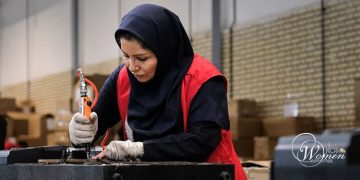
The labor force participation rate of Iranian women has fallen to its lowest level in recent years. According to published statistical data, this rate dropped to 14.7 percent in the fall of 2024, marking the lowest level recorded in recent years.
Based on a report by the Statistical Center and research conducted by Tarbiat Modares University, the gender gap in Iran’s labor market is widening. In the 20–24 age group, this gap has reached 21.1 percent. In addition, the unemployment rate among women in this age group stands at 29.2 percent, compared to 18.9 percent for men.
According to these figures, only 14.4 percent of Iranian women are considered part of the economically active population, while the global average for this indicator is 49 percent.
According to the Statistical Center of Iran, out of 14 million employed individuals, only 2.2 million are women. (ISNA, November 11, 2025)
Recent reviews of employment in Iran’s industrial sector indicate that in winter 2024, a total of 8,144,108 people were employed in this sector. Of these, 7,276,586 were men and 867,433 were women.
During the same period, 133,453 jobs were created for men, while 82,965 women lost their jobs. (Mehr, April 13, 2025)
A look at the unemployment rate among the 15–24 age group points to a deeper crisis. In the spring of 2025, the unemployment rate for this age group nationwide stood at 19.7 percent. The figure was reported at 30.9 percent for young women and 17.4 percent for young men, highlighting widespread gender discrimination in employment opportunities. (Eghtesad Online, 15 July 2025)
The overall unemployment rate is 14.3 percent among women, compared to 6.2 percent for men. This deep gap shows that even among the limited number of women participating in the labor market, a smaller proportion succeed in finding jobs. (Tamin 24, December 24, 2025)
Official government unemployment statistics include only those who are actively seeking work. This means they exclude the large number of housewives, as well as those who have become discouraged from looking for jobs or who are prevented from working by male family members.

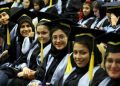
Iranian women have borne the heavy cost of education through great effort and now make up more than 60 percent of the country’s university graduates. Nevertheless, their economic participation rate is only about 14 percent, while this figure reaches 68.4 percent for men. Even among economically active women, 7 out of every 10 unemployed women hold a university degree. (Shargh, November 11, 2025; EcoIran, February 21, 2025)
Maryam Zendehdel, a legal expert, explains: “Educated women, often holding master’s and doctoral degrees, are frequently employed in low-paid positions that are disproportionate to their expertise. This situation is the result of executive practices and the structural conditions of the labor market.” (Shargh, November 11, 2025)
Zahra Karimi, an economist, also notes: “Although employment conditions are extremely difficult for all groups, in Iran women are excluded from many jobs. For example, in government offices, men are given priority when recruiting specialists, even though there is no difference in performance between male and female experts.” (Shargh, November 11, 2025)
Maryam Zendehdel continues: “In the public sector, women face stricter screening processes and are required to meet certain appearance standards that men are not subjected to. In the private sector, marriage and childbearing are major factors limiting women’s employment opportunities, leading to short-term contracts and their frequent termination. After marriage or childbirth, women are easily pushed out of the labor market.” (Shargh, November 11, 2025)