
Tuesday, March 10, 2026
  • English
  • Français
  • فارسی
  • عربى
PODCASTS
NCRI Women Committee Women Resistance Freedom
  • Home
  • NEWS
    • Women’s News
    • Articles
    • Statements
  • PUBLICATIONS
    • Monthlies
    • Documents
    • Reference Library
  • ABOUT US
    • The NCRI Women’s Committee
    • Gender Equality
    • Women’s Platform
  • MARYAM RAJAVI
    • Maryam Rajavi
    • Maryam Rajavi Speeches
    • The Plan on Women’s Rights and Freedoms
    • Ten-Point Plan for the future of Iran
  • VANGUARDS
    • The Fallen for Freedom
    • Heroines in Chain
    • Women of Iranian Resistance
    • Famous Women
    • Women in History
  • EVENTS
    • IWD Conferences
    • Activities
    • IWD Speeches
    • Solidarity
  • VIDEO
    • Videos
    • IWD Videos
  • PODCAST
  • DONATE
  • CONTACT US
No Result
View All Result
NCRI Women Committee Women Resistance Freedom
  • Home
  • NEWS
    • Women’s News
    • Articles
    • Statements
  • PUBLICATIONS
    • Monthlies
    • Documents
    • Reference Library
  • ABOUT US
    • The NCRI Women’s Committee
    • Gender Equality
    • Women’s Platform
  • MARYAM RAJAVI
    • Maryam Rajavi
    • Maryam Rajavi Speeches
    • The Plan on Women’s Rights and Freedoms
    • Ten-Point Plan for the future of Iran
  • VANGUARDS
    • The Fallen for Freedom
    • Heroines in Chain
    • Women of Iranian Resistance
    • Famous Women
    • Women in History
  • EVENTS
    • IWD Conferences
    • Activities
    • IWD Speeches
    • Solidarity
  • VIDEO
    • Videos
    • IWD Videos
  • PODCAST
  • DONATE
  • CONTACT US
No Result
View All Result
NCRI Women Committee
No Result
View All Result
Home Monthlies
Global Gender Gap Report 2023 finds Iran at the bottom of its index

Global Gender Gap Report 2023 finds Iran at the bottom of its index

June 2023 Report: Global Gender Gap Report finds Iran at the bottom of its index

July 5, 2023
in Monthlies

Global Gender Gap Report 2023 finds Iran at the bottom of its index

Monthly-Report-June-2023_ENDownload

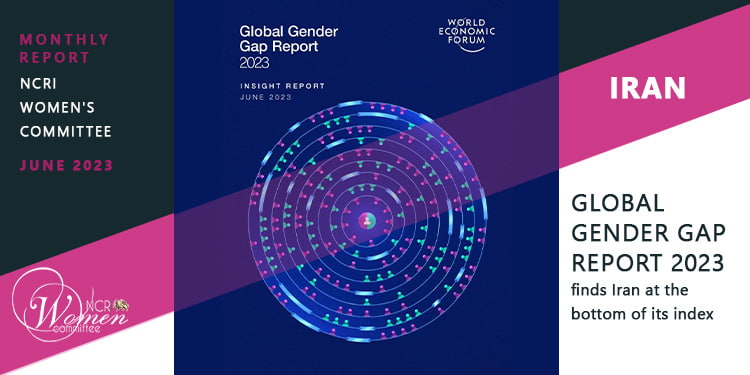
The World Economic Forum released its latest Global Gender Gap Report on June 20, 2023. According to this report, Iran ranks 143rd among 146 countries in the world examined for this report.

The Global Gender Gap Report (GGGR), published by the World Economic Forum (WEF), examines the gender gap and discrimination against women in countries around the world and serves as a reference for measuring the level of gender justice among countries.

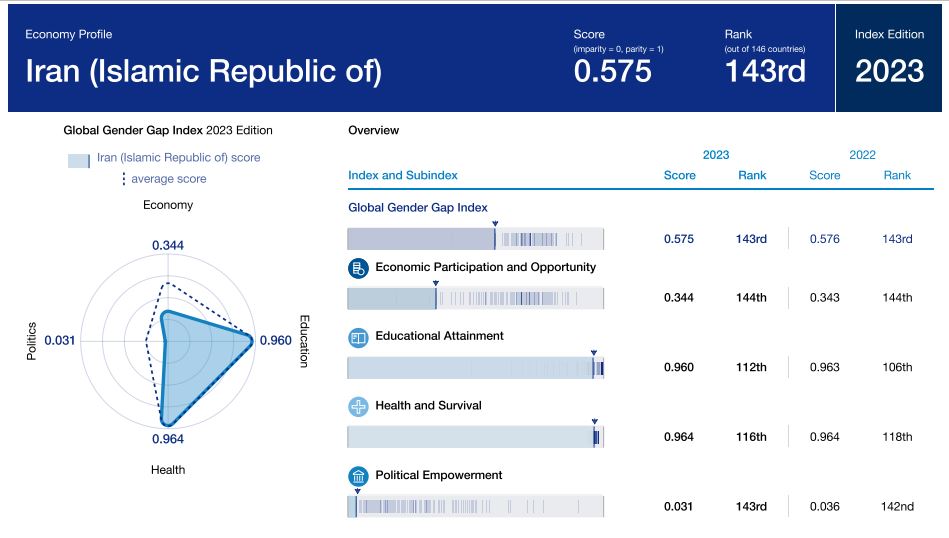
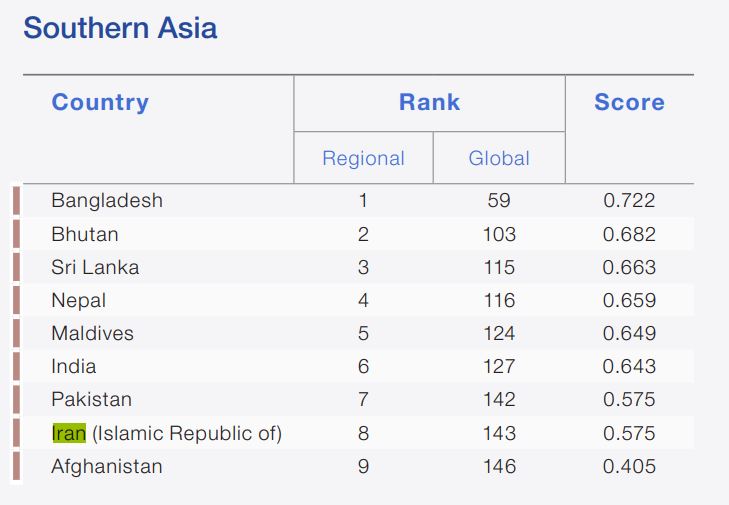
The WEF 2023 report ranks Iran 143rd in terms of gender gap among 146 countries in the world. This denotes a downward trend compared to previous years. In addition, among the nine countries in the South Asia group, Iran ranks eighth, only above Afghanistan.

According to the Global Gender Gap report, parity has backslid in Iran, Sri Lanka, and Afghanistan, as the share of ministerial positions held by women has dropped in these countries since 2022.

Global Gender Gap Report 2023 finds Iran at the bottom of its index

Gender gap index

The index of the gender gap and discrimination against women consists of four subcategories: 1) Economic Participation and Opportunities, 2) Educational Attainment, 3) Health and Survival, and 4) Political Empowerment. The results of these four subcategories determine the country’s rank from the perspective of gender justice.

The research method and statistical analysis of this report are designed with the aim of obtaining effective tools to reduce the gender gap. These methods have remained constant since the beginning of 2006. Although international statistics are essentially based on government statistics, the data from Iran is unclear since the regime is recognized as one of the most corrupt governments in the world regarding corruption indicators.

In this article, we will examine the gender gap and discrimination against women in Iran in economic participation and opportunities.

Participation in the labor market and economic opportunities

Women’s participation in the labor market and equal economic opportunities are among the components included in the gender gap index. This index is measured with sub-indices such as women’s participation rate, income compared to men’s, and participation in high-level jobs.

According to the Global Gender Gap Report 2023, the gender gap index for economic participation and opportunities for Iran is 34.4%, with the labor force participation rate standing at 20.4% in the 146th rank. The Iranian regime continues to hinder economic gender parity with a stark income gap of 17.1 percent in the 145th rank. The percentage of legislators, senior officials, and managers stands at 21.9%, with professional and technical workers’ percentage standing at 53.4%.

Regarding wages for similar work, the gender gap rate for Iran is 54.2%.

Finally, the Political Empowerment subindex registers one of the lowest parity scores for Iran at 3.1%, with women in parliament at 5.9%, women in ministerial positions at 5.3%, and women as heads of state at 0%.

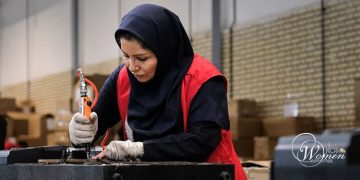
Discrimination against Iranian working women has become normalized under the mullahs’ regime. Although women hold a significant share in the labor market, their rights are systematically violated by the ongoing tolerance for gender discrimination.
Global Gender Gap Report 2023 finds Iran at the bottom of its index

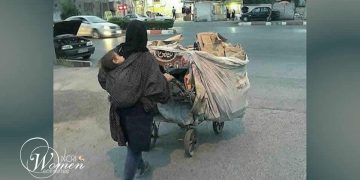
Nineteen percent is the share of employed Iranian women

The mullahs’ dictatorship in Iran and the establishment of a patriarchal and misogynistic culture in society are the most important reasons for the gender gap, discrimination against women, and unemployment among educated Iranian women. The Velayat-e Faqih not only disregards women’s employment but, with all kinds of tactics, tries to push women to stay at home and bear children, excluding them from the community.

Based on the data published by the Directorate on Family and Women’s Affairs, in January 2022, some 27% of university graduates are women. However, their share of employment in Iran is about 19%, meaning that 60% of educated Iranian women are unemployed. Only 40% of skilled and trained women have entered the labor market.

In addition, 70% of working women do not have stable jobs or incomes. This is despite the fact that it has been over 2 years since the COVID-19 pandemic. Due to economic and livelihood crises, many Iranian women have lost their jobs.

Mona, a young woman working in an import trading company, said: “A woman’s capabilities are not important in Iran; men are the first choice for employers.”

Speaking about employment and women’s rights, a researcher stated, “Employers often find it easier to hire and fire women. It has become something very normal for single women to receive lower salaries, and it is easier to fire them because they do not have any support and shelter.”

Equal work, yet women receive lower salaries than men

In Iran, under the rule of the mullahs, the salary of a woman is a quarter of that of a man.

A female lawyer in one of Iran’s southern cities, referring to discrimination against women in Iran, indicated, “In Iran, unfortunately, it has become normal for women to work as much as men but to receive lower wages. Of course, the conditions are worse for single women in cities.

The further into deprived areas and small towns, the more we see of these problems and discrimination. As a lawyer, I have represented various companies and seen how female secretaries were paid less than male secretaries were. Among lawyers, men receive higher attorney’s fees than women. Even male vendors are paid more than their female counterparts.”

On June 26, 2022, Kurdpa News Agency reported that a lawyer and female activist from Marivan described the cheap labor of women in the city’s strawberry fields. These women are paid 200,000 Tomans per day, despite their careful and thorough work in collecting the products. It means their wage is less than one-third of men’s wages for equal work.
Global Gender Gap Report 2023 finds Iran at the bottom of its index

Institutionalization of violence against women

Discrimination against women in employment translates into pressure to keep them at home by encouraging early marriage and pregnancy. The unequal distribution of job opportunities has also deprived women of obtaining jobs over the years.

A significant number of women in Iran, despite having university degrees, have turned to informal jobs, been forced to accept traditional roles at home, or taken jobs that pay lower salaries. Many working women are also forced to stay at home due to sexual harassment at work.

In September 2020, after reports that some female journalists had been subjected to shocking sexual harassment and violence, a small glimpse of the hidden and deep angles of violence and discrimination against working women was exposed. Sarah Ommat-Ali, a journalist who reported being harassed during a job interview, launched a campaign through which many more female journalists narrated their stories of harassment. After that, on November 2, 2020, 23 female journalists published a statement about sexual harassment that corroborated what had happened to Sarah.

Sexual violence against women in Employment

Employment ads in newspapers, websites, and immoral offers to women in so-called job interviews are among the examples of violence against Iranian women and girls for many years in a misogynistic government.

Mina, a single woman who was forced to leave her job several times due to violence, said, “Being a woman in Iran is difficult. A working woman fares worse. But being a single, capable working woman is the hardest of all.”

Mina continued, referring to the regime’s misogynistic and patriarchal thinking, “Even the most enlightened men accept a woman as a secretary and an ordinary employee in the back of their minds. In an equal position between a woman and a man, even if the woman is the better option in terms of competence as a manager or official, the man will definitely be chosen. I work as much as a man, but I get paid much less. Women are rejected easily.”

Discrimination against women is a tool to repress and stress all of society

Political factors drive patriarchal thinking in Iranian society, and many forms of discrimination are clearly institutionalized in the regime’s laws. This is because one of the characteristics of the Velayat-e Faqih regime is misogyny, and the government itself is the main cause of all these sufferings.

The mullahs want to strengthen the foundation of their awful government by promoting a patriarchal culture over society. Discriminating against women serves as a tool to suppress the entire country.

However, Iranian women have defied the regime for the past 44 years. They have proven their equality by leading the anti-government protests across the country, which shows they have already empowered themselves to decide their country’s and their own destiny.
Tags: Gender Gap
ShareTweetPinShareSendShare

Related Posts

A Report to CSW70: Gender-Based Discrimination Under Iranian Law

March 8, 2026
A Report to CSW70: Gender-Based Discrimination Under Iranian Law

Structural Inequality and State-Sanctioned Oppression of Women Gender-Based Discrimination Under Iranian Law” is the title of the NCRI Women’s Committee’s report to CSW70, as it focuses on “Ensuring...

Read moreDetails

Women’s Retirement Made Tougher Under New Social Security Law

July 16, 2025
Women’s Retirement Made Tougher Under New Social Security Law

In a fresh wave of regressive reforms, the Iranian regime has significantly tightened the conditions for women’s retirement under the amended Social Security Law. According to a report...

Read moreDetails

Women’s Economic Participation in Iran Falls to 13% – Lowest in Three Years

July 15, 2025
Women’s Economic Participation in Iran Falls to 13% – Lowest in Three Years

Women’s economic participation in Iran has declined to its lowest point in the past three years. According to official statistics, only 13.1% of Iranian women were economically active...

Read moreDetails

Youth Employment Crisis: Jobless Rate for Young Women Nears 35%

May 29, 2025
Employment Crisis: Jobless Rate for Young Women Nears 35%

New official statistics reveal a deepening employment crisis in Iran, particularly for young women. The figures—published by the state-run Eghtesad News on May 15, 2025—show that unemployment among...

Read moreDetails

The Gendered Face of Poverty in Iran: How Women Bear the Heaviest Burden

May 10, 2025
The Gendered Face of Poverty in Iran: How Women Bear the Heaviest Burden

The Gendered Face of Poverty in Iran - In recent years, the economic crisis in Iran has deepened, with poverty now affecting over 30% of the population by...

Read moreDetails
Next Post
Nazila Maroofian, a 23-year-old journalist, is summoned to Evin Courthouse

Nazila Maroofian, a 23-year-old journalist, is summoned to Evin Courthouse

Documents

A Report to CSW70: Gender-Based Discrimination Under Iranian Law

A Report to CSW70: Gender-Based Discrimination Under Iranian Law

March 8, 2026

Structural Inequality and State-Sanctioned Oppression of Women Gender-Based Discrimination Under Iranian Law” is the title of the NCRI Women’s Committee’s...

Annual Report 2026: From Protests, to Uprising, and the Role of Iranian Women

Annual Report 2026: From Protests, to Uprising, and the Role of Iranian Women

March 3, 2026

On the eve of International Women’s Day 2026, the NCRI Women’s Committee presents its Annual Report 2026, offering a recap...

Iranian women Who Lost Their Lives in Iran’s January 2026 Uprising

Iranian Women Who Lost Their Lives in Iran’s January 2026 Uprising

January 25, 2026

Names That Must Not Be Forgotten Iranian women played a central and courageous role in the January 2026 uprising, standing...

Monthlies

January 2026 Report: Women at the Core of the Uprising
Monthlies

January 2026 Report: Women at the Core of the Uprising

January 31, 2026
December 2025 Report: A Year in Review: Iranian Women’s Resistance Against Religious Dictatorship
Monthlies

December 2025 Report: A Year in Review: Iranian Women’s Resistance Against Religious Dictatorship

January 5, 2026
November 2025 Report: Under the Clerical Regime, Nowhere Is Safe for Women in Iran
Monthlies

November 2025 Report: Under the Clerical Regime, Nowhere Is Safe for Women in Iran

November 30, 2025
October 2025 Report: Death Sentence for a Female Political Prisoner The Resistance of Female Political Prisoners Inspires Iranian Women and Girls in Their Struggle Against the Regime of Executions and Massacre
Monthlies

October 2025 Report: Death Sentence for a Female Political Prisoner

October 31, 2025

Articles

Iranians Rally in Paris, Back NCRI’s Provisional Government, Maryam Rajaiv’s Ten-Point Plan

Iranians Rally in Paris, Back NCRI’s Provisional Government, Maryam Rajavi’s Ten-Point Plan

March 10, 2026

Supporters of the Iranian Resistance rallied in Paris, voicing support for the NCRI’s provisional government to transfer sovereignty to the...

Maryam Rajavi Discusses Iran’s Transitional Roadmap in Interview with Frankfurter Rundschau

Maryam Rajavi Discusses Iran’s Transitional Roadmap in Interview with Frankfurter Rundschau

March 8, 2026

Maryam Rajavi, the President-elect of the National Council of Resistance of Iran, said in an interview with the German newspaper...

March 8: International Women's Day and the Leading Role of Iranian Women in the Struggle for Freedom

March 8: International Women’s Day and the Leading Role of Iranian Women in the Struggle for Freedom

March 6, 2026

March 8 is celebrated worldwide as International Women's Day, a day that honors over a century of women's fight for...

The Fallen for Freedom

Sonya Salehi-Rad was killed on January 8, 2026, during the nationwide popular protests in Shiraz
The Fallen for Freedom

Sonya Salehi-Rad

February 10, 2026
Arezoo Abedi was killed on January 9, 2026, during the nationwide popular protests
The Fallen for Freedom

Arezoo Abedi

February 10, 2026
Arnika Dabbagh, from Gorgan, was killed on January 9, 2026
The Fallen for Freedom

Arnika Dabbagh

February 7, 2026
Maedeh Moradi Kia, a resident of Tehran, was killed on January 9, 2026
The Fallen for Freedom

Maedeh Moradi Kia

February 7, 2026

ABOUT US

NCRI Women Committee

We work extensively with Iranian women outside the country and maintain a permanent contact with women inside Iran. The Women’s Committee is actively involved with many women’s rights organizations and NGO’s and the Iranian diaspora.
The committee is a major source of much of the information received from inside Iran with regards to women. Attending UN Human Rights Council meetings and other international or regional conferences on women’s issues and engaging in a relentless battle against the Iranian regime’s misogyny are part of the activities of members and associates of the committee.

CATEGORIES

  • Activities
  • Articles
  • Documents
  • Famous Women
  • Heroines in Chain
  • IWD Conferences
  • IWD Speeches
  • IWD Videos
  • Maryam Rajavi
  • Maryam Rajavi Speeches
  • Monthlies
  • Podcast
  • Reference Library
  • Solidarity
  • Statements
  • The Fallen for Freedom
  • Videos
  • Women in History
  • Women in Leadership
  • Women of Iranian Resistance
  • Women's News

BROWSE BY TAG

Child marriage coronavirus education execution forced hijab Gender Gap Generation Equality Honor killings Iran Teachers Maryam Akbari Monfared Nurses Plan on Women's Rights and Freedoms Poverty Prisoners Protests rural women Saba Kord Afshari The girl child Violence against women Women's Leadership Women Heads of Household Zeinab Jalalian

The copyright of all the material published on this website has been registered under © 2016 the Women’s Committee of the National Council of Resistance of Iran. To obtain permission to copy, redistribute or publish the material published on this website, you should write to the NCRI Women’s Committee. Please include the link of the original article on our website, women.ncr-iran.org.

Welcome Back!

Login to your account below

Forgotten Password?

Retrieve your password

Please enter your username or email address to reset your password.

Log In

Add New Playlist

No Result
View All Result
  • Home
  • News
    • Women’s News
    • Articles
    • Statements
  • Publications
    • Monthlies
    • Documents
    • Reference Library
  • About Us
    • The NCRI Women’s Committee
    • Gender Equality
    • Women’s Platform
  • Maryam Rajavi
    • Maryam Rajavi
    • Maryam Rajavi Speeches
    • Ten Point Plan for Iran
    • The Plan on Women’s Rights and Freedoms
  • Vanguards
    • The Fallen for Freedom
    • Heroines in Chain
    • Women of Iranian Resistance
    • Famous Women
    • Women in History
  • Events
    • IWD Conferences
    • Activities
    • IWD Speeches
    • Solidarity
  • Video
    • Videos
    • IWD Videos
  • Podcast
  • Donate
  • Contact us
  • فارسی
  • عربی
  • Français

The copyright of all the material published on this website has been registered under © 2016 the Women’s Committee of the National Council of Resistance of Iran. To obtain permission to copy, redistribute or publish the material published on this website, you should write to the NCRI Women’s Committee. Please include the link of the original article on our website, women.ncr-iran.org.