
The Glorious Epic of Resistance by PMOI Women in the Anti-Human Clerical Regime’s Prisons
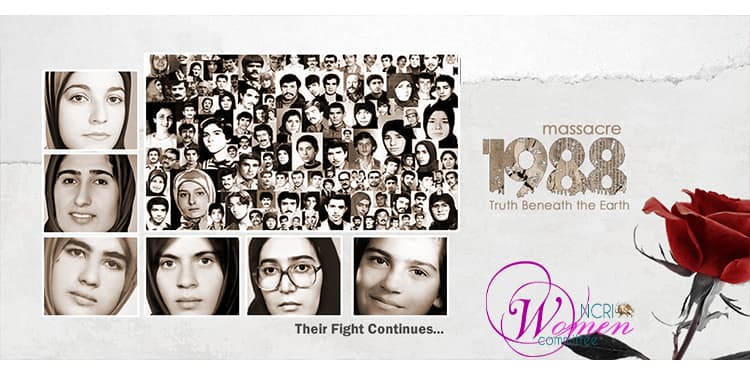
The massacre of over 30,000 political prisoners in the summer of 1988 is recorded as the largest crime against humanity since World War II and the most heinous genocide in modern Iranian history. This horrific tragedy can be termed “the greatest unpunished crime against humanity.” With the massacre decree, Khomeini sought to eradicate an entire generation of PMOI members to guarantee his regime’s survival.
The murderous clerical regime began preparations for this nationwide genocide in the winter and spring of 1988 by segregating, reshuffling, and transferring prisoners between facilities. The machinery of slaughter and crime was set in motion on July 19, 1988, when the infamous Khomeini issued a secret and ruthless edict (fatwa) ordering the execution of all prisoners who remained steadfast in their commitment to resistance and allegiance to the PMOI. In this fatwa, he decreed that all steadfast PMOI members were deemed “mohareb” (at war with God) and must be executed immediately.
Following this fatwa, “Death Commissions”—comprising a Sharia judge, a prosecutor, and a representative of the Ministry of Intelligence (including executioners such as Ebrahim Raisi and Mostafa Pourmohammadi)—were stationed in Evin, Gohardasht, and prisons across the country, commencing their summary trials.
They decided the life or death of prisoners by asking a single question: “Do you still support the PMOI?” Those who answered in the affirmative were blindfolded and sent straight into line to the gallows.
The peak and main wave of the massacre occurred between July 27 and August 16, 1988; however, this crime continued through the autumn of 1988 and, in some regions, into the following year. Over 90 percent of those executed were members and supporters of the People’s Mojahedin Organization of Iran (PMOI/MEK)—most of whom had been arrested in 1981 at school or university age and had already completed their unlawful prison terms. The pure bodies of these martyrs were transported in dozens by dump trucks and buried in unmarked mass graves, such as Khavaran.
One of the aspects that requires serious examination regarding the 1988 massacre of political prisoners is the execution of thousands of women during this crime against humanity and genocide. Assessing the brutal treatment of female political prisoners by the regime’s henchmen is, on the one hand, profoundly harrowing, and on the other, a testament to an epic and remarkable resistance.
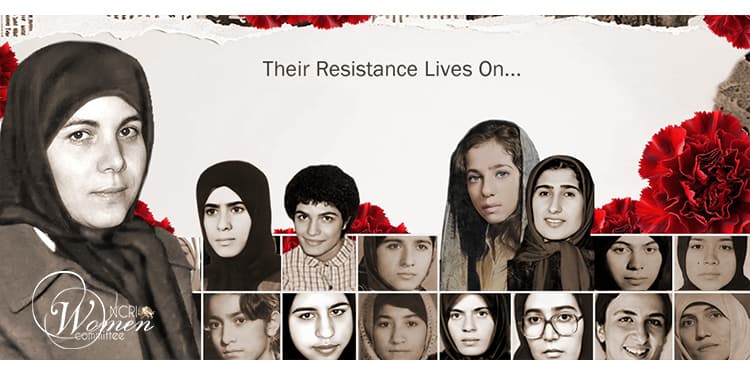
According to eyewitness accounts, in the three women’s wards of Evin Prison, 80 percent of the prisoners were hanged or executed by firing squad by September 1988. During the trial of Hamid Noury, one of the perpetrators of the massacre, the prosecutor of the Stockholm court explicitly explained: “Women were executed in the first wave, and in our investigations, we could not find any women who survived the executions in the women’s ward.” While writing about every single one of those brave women is beyond the scope of this text, we highlight just a few epic figures—a mere handful among the hundreds of bright stars in this galaxy of steadfastness to principles and ideals.
Bright Figures and Icons of Resistance Among PMOI Women
- Monireh Rajavi: A Newcastle University student, symbol of the innocent prisoners massacred in 1988, mother of two young daughters, and sister of Massoud Rajavi, the Leader of the Iranian Resistance. Arrested solely due to Khomeini’s malice toward the Resistance leadership, she stood steadfast and said, “They want to destroy our human identity; we must fight.”
- Everyone was well aware of Monireh’s influence on the other prisoners. Prison authorities soon made it clear to Monireh that whenever the PMOI carried out an operation against the regime, it was she who would be summoned and tortured. Her two young daughters were taken alongside their mother to interrogations and torture sessions. They were forced to witness the brutal cruelty of their mother’s torturers. The interrogators would beat the young girls as well; they cried so hard that even Monireh could not console them. When a fellow prisoner witnessed this scene and asked the mother for her name, she replied: “My name is Monireh Rajavi, and my only crime is being Massoud’s sister.” She was routinely subjected to humiliation and beatings, but they could never break her spirit.
- Fariba Ahmadi and Farahnaz Ahmadi: Two sisters, both members of the PMOI in Isfahan who were arrested at the ages of 17 and 19, receiving harsh sentences of 12 and 15 years in prison. Fariba, who was 22 at the time of her martyrdom, was affectionately remembered as the “Sun of the Prison” for her unyielding resolve. Her sister Farahnaz, who was just 20 when martyred, spent most of her captivity in solitary confinement with heroic fortitude. Despite the brutal and agonizing atmosphere of prison, these sisters transformed their suffering into a symbol of resilience, uplifting their fellow inmates with unwavering hope. They were deeply loved and held a special place in the hearts of all who shared their cell. Following a courageous hunger strike, both Fariba and Farahnaz were executed by firing squad in August 1988 at Dastgerd Prison in Isfahan and laid to rest side by side in Plot 41 of Bagh-e Rezvan Cemetery.
- Sakineh Delfi: A 26-year-old woman of extraordinary courage from Abadan. Her final arrest came in April 1987. To break her resolve and force her surrender, prison authorities shuffled her across three different facilities. Yet Sakineh remained utterly unbroken by the agonizing torture. Ultimately, she was transferred to Fajr Karun Prison in Ahvaz, where the brutality reached horrific extremes: she was burned with a clothes iron, her fingernails were pulled out, metal rods were thrust into her flesh during intense floggings, she was repeatedly suspended by her hair, her knees were drilled into, and she was plunged into icy water in the dead of winter. Through it all, she refused to yield or say a single word. When the regime’s executioner clerics (Jazayeri and Abdollahi) shouted at the prisoners, “Declare your allegiance! It is either Khomeini or Massoud Rajavi!”, Sakineh defiantly shouted back from the end of the ward: “Long live Massoud, Down with Khomeini!” IRGC guards ambushed and brutally battered her. The very next day, out of that 350-prisoner ward, 349 were sent to the gallows.
- The bodies of Sakineh Delfi and her fellow PMOI members, among the first to be executed in the Ahvaz massacre—were buried behind the Ahvaz Steel Complex. To cover up their crime, authorities poured a 30-centimeter layer of lime and cement over the graves.
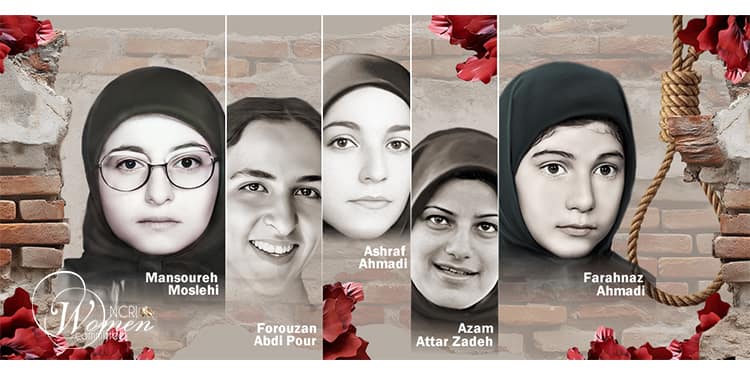
- Ashraf Ahmadi: A political prisoner under the Shah’s regime and a mother of four, she was hanged at Evin Prison in August 1988 after seven years of imprisonment. During her time in prison, she developed severe kidney problems. Drawing on her past experiences under the Shah’s rule, she became a source of strength and a trusted mentor for the other female prisoners. Before being led to execution, inmates would visit Ashraf to say goodbye. Though no one knew what she whispered to them, they always left her side noticeably more comforted and relieved. Throughout her years of torture and interrogation, Ashraf never answered a single question from her interrogators. She refused to attend any court proceedings and was never formally sentenced. In 1987, while she was still behind bars, her husband died in a car accident, leaving their four children without parents. Yet even this tragic loss could not shake her commitment to her beliefs.
- Parvin Haeri: She held a master’s degree in English Literature and endured seven years of horrific torture without breaking. Guards flogged her on torture beds until they were utterly exhausted, yet Parvin refused to submit. In August 1988, at the age of 29, she was hanged at Evin Prison.
- Masoumeh and Mehri Karimian: Dr. Masoumeh Karimian, affectionately known among her comrades as “Shorangiz,” was a UK-educated physiotherapist. Following her arrest in 1981, she was immediately subjected to relentless torture. Her uncompromising spirit drew intense malice from her interrogators; whenever guards sought to punish prisoners, Shorangiz was always among them. Using her medical expertise and the limited resources available in prison, she secretly treated many inmates who suffered severe physical injuries from torture. From 1983 to 1984, Shorangiz was kept in the notorious solitary “cages” of Unit 1 at Qezel Hesar Prison. Severe torture left her with a permanent limp, and she never removed her socks because her feet were so deeply scarred that she didn’t want others to see them. Ultimately, after seven years of unyielding endurance, this devoted physician and her sister Mehri, a university student, were executed by firing squad at Evin Prison on July 30, 1988, during the first wave of the massacres.
- Razieh Ayatollahzadeh Shirazi: She held a bachelor’s degree in physics from the University of Tehran. Bold, energetic, and full of life, she joined the PMOI at the age of 24, shortly before the 1979 revolution. Always the first to volunteer for the toughest tasks, her petite frame belied an unbreakable determination. On June 20, 1981, while two months pregnant, she was arrested during a peaceful demonstration. Until 1988, she was held in Evin and Gohardasht prisons, where she endured extreme torture. Throughout her pregnancy, guards kept her locked in a freezing, windowless cell, causing her to develop severe kidney disease. When her labor began, guards delayed transporting her to an outside hospital. Razieh recalled hearing her newborn daughter cry, but the guards cold-heartedly claimed the baby had died. Known for her endless resourcefulness and creative spirit, she was regarded by her cellmates as a symbol of resilience. On September 25, 1988, she was hanged from a crane in full view of her fellow prisoners.
- Forouzan Abdi: A physical education student and a member of Iran’s national women’s volleyball team. She spent seven years enduring torture and solitary confinement. Yet, even in the direst conditions, she maintained an extraordinary spirit. Because of her steadfast resistance, in late 1982, she and several other resilient prisoners were confined inside a lavatory, where the filthy conditions caused them all to contract severe skin infections. She was later transferred to solitary confinement at Gohardasht Prison. When Forouzan was finally returned to the general ward in late 1984, despite all the grueling hardships she had endured, her spirits remained completely unbroken, she was full of vitality and deep affection for her fellow prisoners. During outdoor recreation time, she organized sports teams and taught volleyball to other inmates. She was among the first group of female PMOI prisoners brought before the “Death Commission” and was executed during the 1988 massacre at the age of 31.
- Maliheh Aghvami: A high school student from Shahroud who joined the PMOI shortly after the 1979 revolution. She was a vibrant, joyful teenager, known for her youthful wit and warm personality. Maliheh was arrested prior to June 1981. Following the start of the 1988 massacre in August, she was brought before the “Death Commission.” While no one knows exactly what transpired during her interrogation, the only surviving document left by her speaks volumes. In a note written in her own handwriting, she wrote: “August 4, 1988 — I, Maliheh Aghvami, was taken to court at 3:00 PM and was informed of my execution sentence. It is now 7:00 PM, and I am being taken to be executed.” Authorities refused to return Maliheh’s body to her family. Later that year, a very young Basij member brought a box of sweets and 500 Tomans to her mother, cold-heartedly telling her: “I was your son-in-law; this is your daughter’s dowry.”
- Effat Esmaeili Eyvanki: She was among the women arrested on the night of June 20, 1981, following a peaceful 500,000-strong demonstration in Tehran. Captured by the IRGC near the Eshratabad Committee, she was transferred to Evin Prison. Throughout her captivity, she was held in Evin, Qezel Hesar, and Gohardasht prisons, enduring long periods in solitary confinement. Effat was known for her immense warmth and affection toward her fellow inmates and her family, to whom she sent loving letters from prison. By the summer of 1988, her sentence had been reduced, and she was due for release. However, when brought before the “Death Commission,” she refused to deny her membership in the PMOI. She courageously stood by her political principles and was sent to the gallows.
- Azadeh Tabib: Arrested in 1984 when she was just 19 years old, Azadeh was subjected to severe torture in Interrogation Branch 7. The brutal beatings led to kidney infections, eye injuries, and hearing loss. At one point, a piece of wire from a flogging cable became embedded in the sole of her foot, causing a serious infection. Despite her dire condition, guards refused to allow her to see an outside doctor because she was targeted for harsher treatment. Yet, despite her extensive injuries, Azadeh remained remarkably resilient—her body was covered in bandages, but she always smiled and lifted the spirits of those around her. During torture, she refused to utter even a groan. Her interrogators grew utterly frustrated by her fortitude; as they beat her, they would shout that they were no longer asking for information but simply wanted to hear her cry out. Still, she remained silent. Azadeh was hanged at Evin Prison during the 1988 massacre.
- Maryam Pakbaz: A brilliant student, Maryam earned her high school diploma in mathematics at the young age of 14. In 1980, when she was barely 15, she was arrested simply for holding a single copy of the PMOI newspaper and thrown into prison. Throughout her imprisonment, she was known for her steadfast resistance. By age 20, severe and continuous torture had left her suffering from numerous physical ailments. Despite her youth, she possessed a remarkably deep political and social awareness. Her interrogators were stunned by her resilience and escalated their pressure and torture to force a confession or repentance. Yet, Maryam courageously stood her ground, refusing to capitulate. In October 1988, after enduring eight years of imprisonment and torture, she was hanged at Evin Prison during the 1988 massacre.

The Shocking Scale of the Massacre of Female PMOI Members
Female PMOI prisoners paid a heavy price during the 1988 massacre, yet they stood firm in their commitment to freedom and courageously said “no” to their executioners. Among the key historical documents confirming this truth is an audio recording released from a August 1988 meeting between Hossein-Ali Montazeri—then Ayatollah Khomeini’s designated successor—and members of the “Death Commission.”
Mass Execution of 300 Female PMOI Members
Montazeri directly referred to the mass execution of 300 female PMOI members, speaking out against the utter brutality of the executioners who showed no mercy—not even to two young women holding French citizenship.
Executed Solely for Their Beliefs
Referring to the case of a young female PMOI supporter in Tehran, Montazeri noted: “When I brought up her final testament, I asked: ‘Did this girl have any history of violence or murder?’ They said no, she was merely a supporter. Can we really execute a young woman who believes in God and the Quran, simply because she says, ‘This Islamic Republic does not align with my views’? Is this truly Islamic jurisprudence?”
Admission to the Execution of a 15-Year-Old Girl and a Pregnant Woman
The audio recording reveals the execution of a 15-year-old girl who had been arrested solely to exert pressure on her brother, who refused to break under interrogation. Because she refused to condemn her brother, she was executed. The recording also contains an explicit admission to the execution of a pregnant woman in Isfahan.
Admission to Torture and Sexual Violence
In his memoirs and the letters that ultimately led to his dismissal as Khomeini’s successor, Montazeri wrote: “Young women and girls were subjected to brutal torture prior to their execution… If you insist on enforcing your decree, at least order an exception for women, especially mothers.”
Investigations by International Experts and Specialists
- Geoffrey KC, a prominent human rights lawyer and former President of the UN War Crimes Court in Sierra Leone, conducted extensive investigations into the 1988 massacre. Identifying the 1988 atrocities as the most egregious among three horrific post-WWII massacres of prisoners, he stated: “The third, the worst example, came in 1988 when thousands upon thousands of prisoners who were in the first-place members of the MEK, then they came to the atheists, for the communists, for the liberals. People who were in prison for their politics, many of them had served their sentences; they’d been arrested in 1981 and were being held in prison although they finished their sentence, were killed, monstrously, and this is why, this dreadful act has never been punished.”
- In his report on the execution methods, he wrote: “They were hung from cranes 4 at a time, or in groups of 6, from ropes hanging from the front of the stage of the assembly hall. Some were taken to army barracks at night to be shot by firing squad. Their bodies were packed in refrigerator trucks to be buried at night in mass graves. Months later, families were handed only a plastic bag containing a few belongings of their child, while authorities refused to provide any information regarding the location of the graves.”
- “The summary, arbitrary and extrajudicial executions during 1981–1982 and 1988 amount to crimes against humanity—including murder and extermination—as well as genocide and atrocity crimes. Crimes against humanity also include torture, imprisonment, and enforced disappearances. The continuation of these crimes stems from the impunity enjoyed by perpetrators who remain at top levels of power.”
- “An enforced disappearance continues until the fate and whereabouts of the individual concerned are established, regardless of how much time has passed. Family members have the right to know the truth regarding the fate and whereabouts of the disappeared persons, and the identity of the perpetrators. This obligation applies regardless of whether the victims were described as ‘terrorists’ or threats to national security.”

We will neither forgive nor forget!
The pure blood of over 30,000 executed martyrs of 1988, and in particular the eternal epic of PMOI women, has forever nullified the legitimacy of the misogynistic Velayat-e Faqih regime; an epic that will remain the guiding torch for justice-seekers and freedom fighters until the complete overthrow of this regime and the establishment of freedom and justice in Iran.