
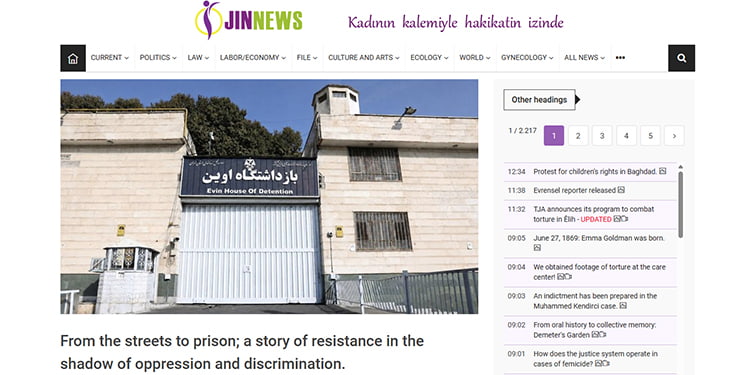
Turkey’s JINNEWS, one of the region’s well-known news outlets covering women’s issues and human rights, published a report on June 24, 2026, on the situation of women prisoners in Iran, written by Melek Avcı.
Founded in 2017, this independent news outlet specializes in reporting on women’s rights, gender-based violence, human rights, prison conditions, and political and social developments in Turkey, Iran, and across the Middle East.
Since 2022, Melek Avcı has published numerous reports and interviews on women’s rights, human rights, political prisoners, developments in Iran, and social movements. Through interviews with civil society activists, academics, politicians, and human rights organizations, she has consistently covered issues related to women, Iran, and the broader region, and is recognized as one of JINNEWS’ prominent journalists specializing in women’s rights and human rights.
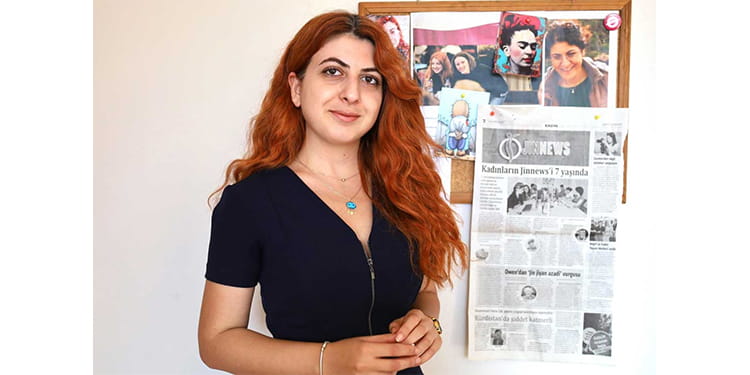
Below is the full text of Melek Avcı’s article, originally published by JINNEWS.
From the streets to prison; a story of resistance in the shadow of oppression and discrimination
Forced labor, denial of healthcare, solitary confinement, torture, and threats of execution. In Iran, female prisoners face systematic human rights violations in prisons. Human rights organizations point out that these practices are a reflection of misogynistic policies.
Women in Iran have faced various forms of discrimination, restrictions, and oppression for years. What women’s rights advocates today describe as “structural misogyny” is not limited to laws and regulations; it also manifests itself in the practices women face in various areas of social, cultural, and political life. These practices, ranging from restrictions on clothing and public presence to repression against female political activists, place women under more intense pressure than other segments of society.
In recent years, particularly following widespread waves of protests, numerous women have been arrested for their social and political activities or for participating in protests. Many of these women are currently imprisoned in harsh and inhumane conditions, as documented in numerous reports. Prison can be seen as the final link in a chain that begins with the restriction of women’s rights within society; this oppression continues even more severely behind prison walls.
Exploitation of women’s labor in prison
One of the most alarming problems in Iranian prisons is the widespread use of prisoner labor. According to reports from Vakilabad prison in Mashhad and several other women’s prisons, prisoners are forced to work in various workshops and production activities. Human rights advocates have stated that the conditions under which prisoners are forced to work for very low wages and under various forms of pressure are an example of the exploitation of prisoner labor. The United Nations and special rapporteurs have described this practice in some cases as an example of “modern slavery” and “crimes against humanity.”
Health barriers are being used as a tool of oppression.
Beyond labor exploitation and forced labor, the deliberate policy of denying women prisoners access to healthcare and medical services is a serious problem. Numerous reports from Qarchak, Evin, Ghezel Hesar, and other prisons indicate that prisoners’ access to doctors, medication, and specialized medical services is severely restricted. In some cases, delays in transferring patients to hospitals or the failure to provide necessary treatment have led to serious consequences. Human rights organizations frequently warn that the deliberate denial of healthcare services has become a tool to exert pressure on prisoners.
The captive women are in quarantine conditions.
The situation at Qarchak Prison in Varamin, long considered one of the worst prisons for women, is a clear example. Reports have revealed overcrowding, inadequate hygienic facilities, drinking water shortages, poor ventilation, and limited access to medical services.
In recent weeks, numerous reports have emerged regarding the inhumane conditions in which female political prisoners are held at Wakil Abad prison in Mashhad. According to human rights organizations, at least 30 women, most of whom were arrested as a result of the actions and raids in January 2026, are being held in quarantine conditions in the “Aramesh” ward, a cramped basement cell with low ceilings, inadequate ventilation, and lack of light. These areas are described as narrow, poorly ventilated, and devoid of daylight; they suffer from overcrowding, a shortage of beds, and problems accessing healthcare.
Dozens of women were tortured in Sirjan prison
Human rights sources have also published a report on the widespread arrests of women participating in the protests in Sirjan and their conditions in Sirjan prison. According to this report, following the protests in Sirjan in January 2025, approximately 400 people were arrested, including dozens of women; most of these women were subjected to weeks of psychological and physical pressure, torture, and interrogation in Sirjan prison; they were then released on high bail and are expected to face harsh sentences while awaiting trial. Among these women are Dr. Sepideh Fakharian, Dr. Nastaran Korki, and Zohreh Ghorbani, all doctors, and the charges against them are mostly stated as “leading the protests,” “insulting the regime,” and similar grounds.
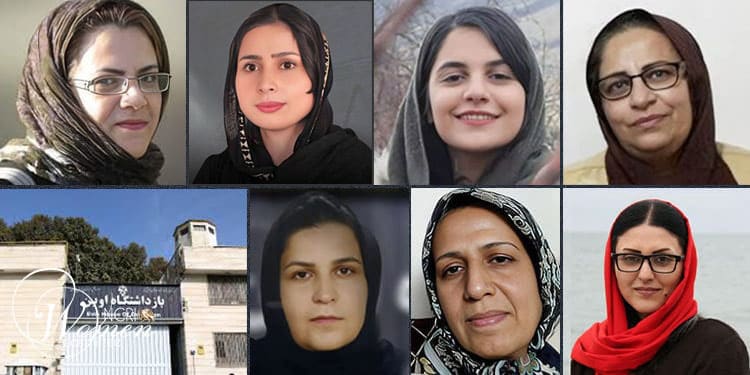
The situation of political prisoners in Ghezel Hesar and Evin Prisons
In recent weeks, reports have emerged of increased pressure on female political prisoners in the women’s ward of Evin Prison. According to these reports, a number of women prisoners, including Shiva Esmaili, Marzieh Farsi, Forough Taghipour, Zahra Safaei, Golrokh Iraei, Sakineh Parvaneh, and Elahe Foladi, have been banned from speaking to their families by phone.
Many of these women are active supporters and members of the People’s Mojahedin Organization (PMOI). Some have been imprisoned for years on charges of supporting the PMOI. Human rights advocates say that cutting off communication with family, limiting contact with the outside world, and imposing new restrictions are among the methods used to increase psychological pressure on female political prisoners. Simultaneously, reports have also surfaced regarding the conditions of prisoners held in Ghezel Hesar prison during recent events.
According to these reports, many prisoners are being held in overcrowded cells lacking adequate facilities. Lack of access to water, extreme temperatures, and limited access to hospitals are among the problems cited regarding this prison.
Prison policy is a reflection of misogyny
However, the situation of women in prison cannot be examined separately from the general situation of women in Iranian society. The extensive restrictions that women face outside of prison in social, cultural, and political spheres are manifested even more severely and brutally inside prison.
Therefore, many women’s rights advocates believe that the situation of women in prison is not only related to the prisons themselves, but is also a reflection of the discriminatory and misogynistic perspective that exists within the governing structure in Iran.
Membership is sufficient grounds for the death penalty
The situation of female prisoners in Iran goes beyond ordinary human rights violations and is used as a tool of gender and political oppression. Among these, the situation of women in the People’s Mojahedin Organization of Iran (PMOI) is reportedly the most alarming, where even “membership of the organization” is considered equivalent to torture and execution.
Zahra Tabari, a 68-year-old engineer, was sentenced to death for the second time on charges of membership in the PMOI. The accusation against her was her unwavering support for the organization.

The resistance continues
The torture and oppression suffered by women prisoners in Iran is not just the story of a single group of prisoners; it is part of a broader struggle by Iranian women to achieve equal rights, human dignity, and fundamental freedoms.
As long as discrimination and misogyny continue under the current regime, the prison walls will continue to reflect an even more intense and painful reality. Despite all this oppression, Iranian women have demonstrated through their resistance in recent years that they are among the main forces demanding freedom, equality, and human rights in society; this demand continues from the streets to behind bars.