
Sunday, November 22, 2026
  • English
  • Français
  • فارسی
  • عربى
PODCASTS
NCRI Women Committee Women Resistance Freedom
  • Home
  • NEWS
    • Women’s News
    • Articles
    • Statements
  • PUBLICATIONS
    • Monthlies
    • Documents
    • Reference Library
  • ABOUT US
    • The NCRI Women’s Committee
    • Gender Equality
    • Women’s Platform
  • MARYAM RAJAVI
    • Maryam Rajavi
    • Maryam Rajavi Speeches
    • The Plan on Women’s Rights and Freedoms
    • Ten-Point Plan for the future of Iran
  • VANGUARDS
    • Women in Leadership
    • Fallen Trailblazers of Iran’s Freedom
    • Fallen Heroes of Iran Uprisings
    • Heroines in Chain
    • Women of Iranian Resistance
    • Famous Women
    • Women in History
  • EVENTS
    • IWD Conferences
    • Activities
    • IWD Speeches
    • Solidarity
  • VIDEO
    • Videos
    • IWD Videos
  • PODCAST
  • DONATE
  • CONTACT US
No Result
View All Result
NCRI Women Committee
No Result
View All Result
Home Solidarity
Zahra Amanpour :Two Parallel Irans: 2 Different Visions and Two Different Destinies for the Iranian People

Two Parallel Irans: Two Different Visions and Two Different Destinies for the Iranian People

October 6, 2026
in Solidarity
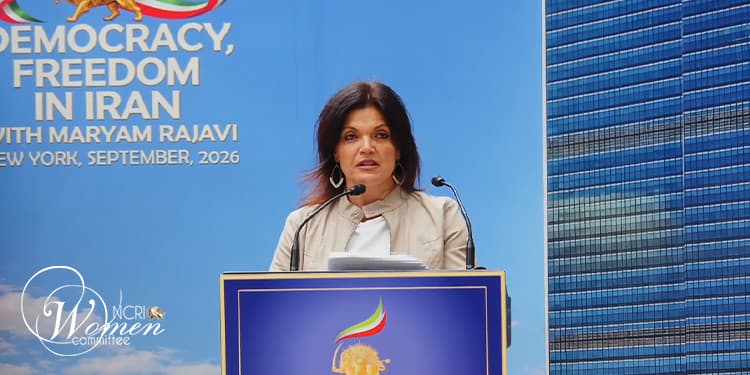
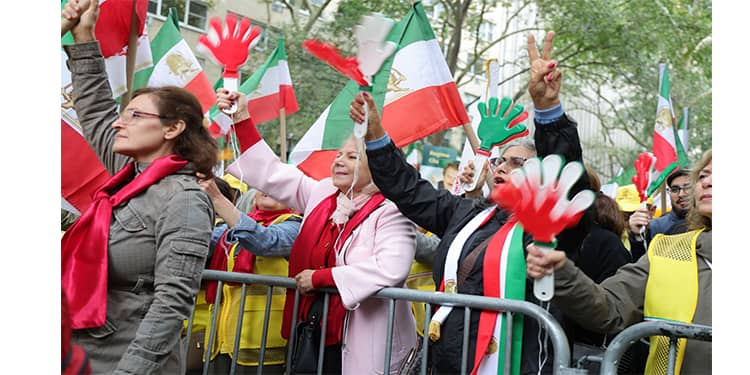
NEW YORK, Sept. 22, 2026 – Thousands of freedom-loving Iranians and supporters of the Iranian Resistance gathered outside United Nations headquarters for two days, to protest the reception of Masoud Pezeshkian, arguing that the Iranian regime’s president does not represent the people of Iran.
Zahra Amanpour, a successful entrepreneur, women’s rights advocate, and a strong voice for democracy and human rights, was one of the speakers at this gathering.

Zahra Amanpour was born in Tehran during the 1979 Revolution and, as an infant, fled Iran with her family. Her father joined the Iranian Resistance and was killed by the regime in the summer of 1988. Rather than allowing this loss and grief to limit her life, she transformed it into a purposeful motivation and became a strong voice for democracy and human rights.

The text of her speech at this gathering is presented below:

Friends, today, as the leaders of the world gather inside the United Nations, I want to talk to you about two Irans. Two parallel worlds representing two very different visions and, ultimately, two very different destinies for the Iranian people.

For more than a century, Iranians have struggled for the right to determine their own future, and twice, dictatorship has stood in their way. Under the Shah, political power was concentrated in a monarchy. Opposition was suppressed, political prisoners were tortured, and SAVAK became a symbol of fear and repression.

So, in 1979, millions of Iranians took to the streets. They did not march because they wanted a religious dictatorship. They marched because they wanted freedom, political participation, and a government that belonged to them. But that revolution was stolen.

The Shah’s crown was replaced by the mullah’s turban, and political repression was joined by religious coercion. Tens of thousands of political prisoners have been executed, protesters have been shot in the streets, and women have faced a system of control over their bodies, their choices, and their place in society. But running alongside this history of dictatorship is another history: the history of organized resistance.

The People’s Mojahedin of Iran, also known as the PMOI or the MEK, was founded 61 years ago on the conviction that the Iranian people deserve freedom and popular sovereignty. And all of you standing here today are part of that history. Your presence is a testament to a struggle that has endured across generations and to an unwavering commitment that replacing one dictatorship with another will never be enough.

That brings us to the two Irans before us today. In one, authority is concentrated at the top. Under the monarchy, sovereignty ultimately rested with the Shah. Under the Islamic Republic, ultimate authority rests with the Supreme Leader and institutions the Iranian people cannot freely choose or remove.

The alternative presented by the Iranian resistance is a democratic republic based on elections, political pluralism, separation of religion and state, equality, minority rights, and the rejection of hereditary rule. And perhaps, nowhere is this contrast more powerful than in the role of women.
Zahra Amanpour :Two Parallel Irans: 2 Different Visions and Two Different Destinies for the Iranian People

Is Democracy Possible Without Women’s Participation and Leadership?

The Iranian regime has spent more than four decades writing discrimination against women into law and using the power of the state to restrict their choices and participation in public life. The MEK stands as a majority-women-led movement that has transformed women’s freedom from a promise into a governing principle, embedding equality into its vision for Iran’s political future.

For more than three decades, women have assumed the organization’s highest executive responsibilities. This month, Mahnaz Meimanat became the 10th successive woman to serve as Secretary General of the People’s Mojahedin of Iran.

Mahnaz entered the struggle as a university student. Her mother was killed by the Revolutionary Guards. Two of her brothers were executed, including one during the 1988 massacre. Yet, she continued taking on greater responsibility until ultimately being elected the leader of the organization.

Think about that contrast: a regime that has devoted enormous power to restricting women, confronted by a resistance movement in which women have spent decades exercising political and organizational authority.

Neither Monarchy nor Religious Dictatorship: What’s the Alternative?

These are the two destinies before Iran. One says power belongs to the Shah or a Supreme Leader. The other says sovereignty belongs to the Iranian people.

Iranians did not struggle against monarchy to create religious tyranny, and the answer to religious tyranny is not to recreate monarchy. The unfinished promise of generations of Iranian struggle is the right of the Iranian people themselves to determine what comes next.

That is the Iran I believe in, an Iran where women and men are equal, beliefs are freely chosen, leaders are elected rather than inherited, and governments belong to the people rather than the people belonging to their government.

That is the Iran that my father, Mehrtash Amanpour, fought for and died for in 1988, and this is the Iran I want my children to inherit.

That is the Iran that every Iranian deserves. The future of Iran belongs to the Iranian people.

ShareTweetPinShareSendShareShare
Next Post
Week 141 of No to Execution Tuesdays Calls for Revoking Protesters' Death Sentences

Week 141 of No to Execution Tuesdays Calls for Revoking Protesters' Death Sentences

Recent Posts

Elaheh Fouladi; Knee Surgery Denied in Evin Prison

Ongoing Medical Neglect of Elaheh Fouladi; Knee Surgery Denied in Evin Prison

November 22, 2026
No Price for Killing Daughters: Child Marriage, Failed Protection, and Unpunished Violence in Iran

No Price for Killing Daughters: Child Marriage, Failed Protection, and Unpunished Violence in Iran

November 21, 2026
Tragic Murder of 3 Young Women in One Week Fardis Prison Maryam Akbari Monfared NCRI Women’s Committee Condemns the Arrest of Nasrin Sotoudeh Iran: International Conference “Women’s Leadership: an Imperative for A Free Iran and A Democratic Republic” Held on the Eve of International Women’s Day Goli Koohkan Life of Political Prisoner Somayeh Rashidi in Danger Call to Prevent the Appointment of an Apologist of the Iranian Regime to the UN Human Rights Council’s Advisory Committee Political prisoner Arghavan Fallahi Pakhshan Azizi Death Sentence upheld Criminal Chastity and Hijab law Deprivation of Visits Female political prisoners Maryam Akbari Monfared Evin Prison morality police protest women political prisoners 4 female prisoners Sharifeh Mohammadi Three Women Nika Shakarami improper veiling participation Masoumeh Senobari Roya Heshmati political prisoner Maryam Akbari Monfared Political prisoners Samira Sabzian female journalists European Parliament Peace Prize NCRI Women’s Committee calls to support women imprisoned in Iran poisoning Veil Watchers 11 political prisoners

Iran: The Tragic Murder of 3 Young Women in One Week

November 20, 2026
Political Prisoner Fatemeh Akbari Transferred to Unknown Location Amid Deteriorating Health

Political Prisoner Fatemeh Akbari Transferred to Unknown Location Amid Deteriorating Health

November 20, 2026
Iran: Kowkab Badaghi Pegah’s Second Retrial Request Rejected

Iran: Kowkab Badaghi Pegah’s Second Retrial Request Rejected

November 19, 2026
Sogand Sayyadi: When a School Sent a 16-Year-Old Girl Back to Death

Sogand Sayyadi: When a School Sent a 16-Year-Old Girl Back to Death

November 18, 2026
Soghra Azarmi: Iran’s First Female Pathologist and a Pioneer in Early Cancer Detection

Soghra Azarmi: Iran’s First Female Pathologist and a Pioneer in Early Cancer Detection

November 18, 2026
Iran: Sara Mousighi at Risk in Qarchak Prison

Sara Mousighi at Risk in Qarchak Prison

November 17, 2026

  ABOUT US   

We work extensively with Iranian women outside the country and maintain a permanent contact with women inside Iran. The Women’s Committee is actively involved with many women’s rights organizations and NGO’s and the Iranian diaspora.
The committee is a major source of much of the information received from inside Iran with regards to women. Attending UN Human Rights Council meetings and other international or regional conferences on women’s issues and engaging in a relentless battle against the Iranian regime’s misogyny are part of the activities of members and associates of the committee.

CATEGORIES

Articles
Documents 
Fallen Heroes of Iran Uprisings
Fallen Trailblazers of Iran's Freedom
Heroines in Chain
IWD Conferences
Maryam Rajavi
 Maryam Rajavi Speeches

Monthlies 
 Podcast
Reference Library
Solidarity
Statements
Videos
Women in Leadership
Women's News

Privacy Policy / Terms of Use / Contact Us /  Donate

Donations are securely processed through PayPal. Payment information is handled by PayPal in accordance with its privacy policy and applicable terms.

The copyright of all the material published on this website has been registered under © 2016 the Women’s Committee of the National Council of Resistance of Iran. To obtain permission to copy, redistribute or publish the material published on this website, you should write to the NCRI Women’s Committee. Please include the link of the original article on our website, https://wncri.org

Welcome Back!

Login to your account below

Forgotten Password?

Retrieve your password

Please enter your username or email address to reset your password.

Log In

Add New Playlist

No Result
View All Result
  • Home
  • News
    • Women’s News
    • Articles
    • Statements
  • Publications
    • Monthlies
    • Documents
    • Reference Library
  • About Us
    • The NCRI Women’s Committee
    • Gender Equality
    • Women’s Platform
  • Maryam Rajavi
    • Maryam Rajavi
    • Maryam Rajavi Speeches
    • Ten Point Plan for Iran
    • The Plan on Women’s Rights and Freedoms
  • Vanguards
    • Fallen Trailblazers of Iran’s Freedom
    • Fallen Heroes of Iran Uprisings
    • Heroines in Chain
    • Women of Iranian Resistance
    • Famous Women
    • Women in History
  • Events
    • IWD Conferences
    • Activities
    • IWD Speeches
    • Solidarity
  • Video
    • Videos
    • IWD Videos
  • Podcast
  • DONATE
  • Contact us
  • فارسی
  • عربی
  • Français