
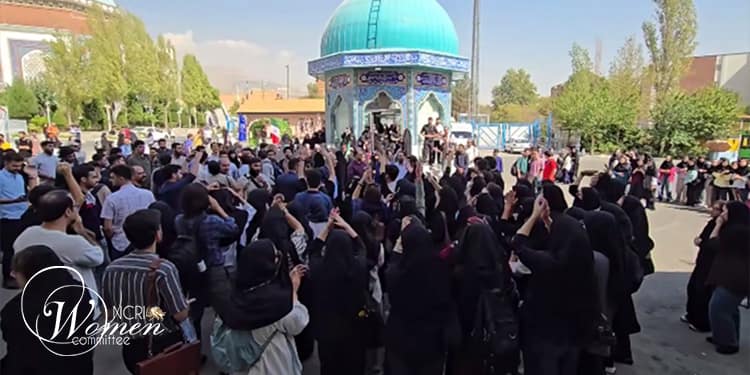
The Allameh University protest took place on Monday, September 28, as students gathered to protest compulsory hijab, the repressive atmosphere prevailing on university campuses, and worsening educational and economic conditions.
The gathering, marked by the prominent participation and leadership of female students, demonstrated that student protests are not limited solely to academic and welfare demands.
In addition to protesting tuition increases for evening-program and extended-study students, the demonstrators also criticized poor dormitory conditions, the low quality of welfare services, compulsory hijab, and the repressive environment imposed on the university.
During the gathering, students chanted:
- “Until the clerics are gone, this homeland will not be a homeland.”
- “High prices and inflation are the scourge of the people.”
- “Exploitation, unemployment, compulsory hijab for women.”
- “We don’t want a university run for profit, we don’t want it!”
- “Top-ranked students living in makeshift dormitories.”
- “Unemployment, unemployment, and your hijab is compulsory too.”
- “The streets are soaked in blood, our professors remain silent.”
- “Students and teachers, unity, unity.”
- “They speak of dialogue, but point their guns at us.”
These slogans showed that students do not view the university’s current problems merely as the result of poor educational management; rather, they see them within the broader context of political repression, gender discrimination, and the economic crisis affecting Iranian society. Among the demands raised, opposition to compulsory hijab occupied a prominent place, a theme made even more visible by the active participation of female students in the protest.
Students Respond to Basij Threats
During the Allameh University protest, members of the university’s Basij organization attempted to divert the students’ demonstration and disperse the gathering under the pretext of “dialogue.” However, according to published reports, some of these forces simultaneously threatened students by saying, “We’ll put you in sacks.”
In response, the students chanted, “We don’t want your dialogue in a sack, we don’t want it!”, delivering a clear and decisive answer to the threats made by the Basij forces.
In Iranian political and protest discourse, being “put in a sack” is commonly associated with intimidation, arbitrary detention, abduction, or the forcible removal of protesters. By chanting “dialogue in a sack,” students highlighted what they saw as the contradiction between the authorities’ calls for dialogue and the threats directed at protesters.