

November 15, 2025 – The Free Iran Convention 2025 was held in Washington, D.C., bringing together hundreds of researchers, specialists, human rights defenders, youth, and leaders of the Iranian American community from across the United States. Prominent supporters and figures from around the world also joined the convention.

In the second panel of the Free Iran Convention 2025, titled “Iranian Women and the Legacy of Resistance,” the role of women as a decisive force in shaping Iran’s democratic movement was examined. Drawing on over a century of struggle and four decades of organized resistance, the panel explored how Iranian women—who have long been targeted by discrimination, repression, and state violence—have become the architects of strategy, organization, and leadership within the opposition. With the participation of leading experts and human rights defenders, the session focused on how women’s resilience, sacrifice, and insight have placed them at the center of the struggle for a democratic, secular, and non-nuclear Iran.
Ana Sami: Our second panel, “Iranian Women and the Legacy of Resistance”. Now, ladies and gentlemen, we will turn to one of the most transformative forces driving change in Iran, Iranian women. We are honored to welcome four extraordinary women whose achievements embody the spirit of resistance and renewal. Please join me in welcoming our panelists.

Dr. Ramesh Sepehrrad- scholar practitioner, published author and leading expert on technology, cybersecurity, and Iran policy
We are going to be discussing how, despite all the brutal violence, the Iranian women continue to endure, continue to be empowered, and continue to reach a leadership that we see today. It’s extremely important that we understand how Iranian women have become a decisive force for change, a change for a democratic Iran, and a change that is really an inclusive change. We see women from all walks of life. We see women from all different parts of Iranian nationality, Azari, Turk, Kord, Baluchi, Lor, every nationality of the Iranian population and the country is represented among the ranks and file of the Iranian resistance.
Today, though, we are going to be talking about the culture, the culture that turned generation of repressed women to organized leadership that has structure, strategy, and purpose. The women of MEK and the broader NCRI coalition have shown that the discipline and sacrifice and strategic clarity have defined the movement for decades. And we have acknowledged that the regime has responded with brutality.
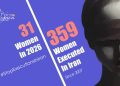
There are no other countries in the world that has executed more women than the Iranian regime. That is a fact, ladies and gentlemen. But it’s also a fact that it shows that Iranian women are not giving up. They’re fighting, they’re resilient, they’re organized, they have a vision, they have strategy, they have a roadmap, and more importantly, they have a leader. That’s right. They have a leader, a leader that had talked about a 10-point plan as referred to in the previous panel.

Dr. Azadeh Sami- Board certified pediatrician in Fairfax Virginia
As you said, the leadership of women did not come without struggle, and it certainly did not come overnight. Under the monarchy, elite women had selective visibility, but politically active women faced constant surveillance, arrest, torture, execution, and exile. Then the clerical regime came and converted misogyny into state doctrine, with the compulsory hijab, with the discriminatory family laws, and gender apartheid. All of these became tools of political control. Since then, from early on, the regime imprisoned, tortured, executed, and massacred women. And this was all because the regime felt and still feels threatened by women. They knew that women’s emancipation means the end of tyranny.
So what did the MEK do? And this was brilliant. They formulated and they formally implemented an emancipatory leadership framework that put qualified, committed women in senior, strategic, and operational roles. So this created a real pathway for women to lead, to organize, and to command. Now, 30 years later, this has made the MEK the longest-running women-led movement in the region. We have women who are operational leaders inside and outside of Iran.
The resistance units contain a strong female core, and this is something that the regime has actually confessed. And the diaspora rallies show powerful cross-generational participation of youth, women, and girls. So in short, we can say that it was this systemic oppression that allowed the leaders to emerge. But not only that, the MEK created the structure to empower these women. This is the egalitarian path toward a free, democratic Iran that is lived in practice and not just in theory.
Dr. Sepehrrad: Give me your thoughts about the issue of hijab.
Dr. Sami: The debate over the hijab in Iran, is often just framed too narrowly because it’s not about the fabric itself. And this is key, but it’s the question of choice and political agency. That’s what it’s about. Under Reza Shah in 1936, women were forced to unveil and actually many veiled girls were pulled out of school. Then the clerical regime comes 40 years later and forces the veiling and turns it into a pillar of political control.
So what do these two scenarios have in common? They both deny women the right to choose. So when Iranian women are demanding freedom, they’re not just simply debating dress codes. They’re challenging a state compulsion in all of its forms. And their demands go far beyond hijab, and it reflects a broader struggle for equality, dignity, and participation in public life.
This is also why when we look at Maryam Rajavi’s point of view, it’s very clear as she says, no to compulsory hijab, no to compulsory religion, no to compulsory government. And at the heart of this statement is the notion of choice and rights. In Iran today, women are shouting, with hijab, without hijab, let’s march to a revolution. And that basically sums it up.

Hannaneh Amanpour-Esq., attorney based in Northern Virginia
The regime intended in its constitution to keep women from having any sort of equal rights under the law. Yet somehow, we continue to see Iranian women finding their way to the front lines of the resistance. And it’s sort of this amazing phenomenon of how it is that that comes to be. So, I think within the MEK we can look at a really sort of brilliant model of how that came to be. Starting in the early 80s, in 1985, we started to see women being put into positions of political, diplomatic, organizational power and whatnot within the MEK. And then in 1993, we actually see Mrs. Maryam Rajavi become the president-elect of the NCRI.
And so, what this demonstrates within the MEK is this model that is representative of what is to come, what the potential is for Iran after the democratic transition, and what we can potentially see for Iranian women inside of Iran. Sadly, this progress that we see has not come with any small sacrifice. Within the MEK we often see not only is the MEK routinely demonized by the regime and their supporters, we see this emphasis on the women members of the MEK, where they’re most targeted for the sacrifices that they’ve made. And again, this is not a mistake, this is by design and it’s intended to sort of confront this tried-and-true egalitarian model that they’ve put into place that demonstrates that you can, in fact, have a society with equal rights under the law for everyone and so that’s why they’re targeted.

Dr. Sepehrrad: Your thoughts on hijab?
Hannaneh Amanpour: There really is no conflict between a woman that says, I choose to wear hijab, or the woman that says, I choose not to wear hijab. Because at the end of the day, what is important is that it is their choice of how and what parts of themselves they want to present to the world. So when I look at my sister in the revolution who does wear hijab and my sister in the revolution who does not wear hijab, there’s absolutely no conflict there between them. And we can equally fight for women’s rights under the law where everyone has the choice to wear whatever it is that they want to wear and whatever it is that makes them feel most powerful and confident in this world.

Dr. Azadeh Zangeneh- internal medicine physician based in Cleveland Ohio
And I think that reality has really, it connects to the deeper history of Iranian women and their pivotal roles as the backbone of every major movement for change, from the 1906 constitutional revolution to the struggle against the monarchy to the 1980s crackdown and to the most recent crackdowns. The theme here is that women have led these revolutions. The MEK’s woman-led model is an extension and an elevation of this historical struggle. For decades, women inside Iran and inside the MEK have held real leadership, not symbolic but in practice, in operational roles, strategic roles, roles that require a lot of discipline, sacrifice, and vision. This organization has really broken the glass ceiling when it comes to women in leadership.

They hold key roles. And this wasn’t incidental. It was a strategic correction to male-dominated norms inside and outside Iran. And as a revolutionary necessity to break free from the patriarchal norms and foundation for building a true democratic Iran.