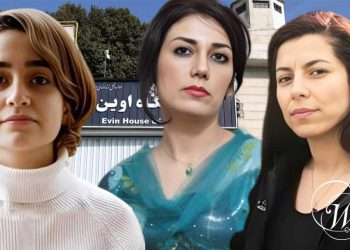

Armita Paveer Placed in Solitary Confinement in Tabriz Prison
Armita Paveer, a political prisoner held in the Central Prison of Tabriz, has been placed in ...
Read moreDetails

Female political prisoners in Iran are victims of an arbitrary legal process.
Ever since the fanatic mullahs’ rise to power in 1979, many dissidents have been facing imprisonment, torture, and execution.
Women made up about one-third of the inmates massacred in 1988 on Khomeini’s Fatwa.
The Iranian regime has continued to clamp down on dissent and incarcerate human rights activists and political opponents since 1980. Many civil activists and human rights defenders are held behind bars.
Since August 2013 until the end of January 2020, 105 women were executed during Hassan Rouhani’s tenure as the mullahs’ president.
The main place were female political prisoners are detained is the women’s ward of Evin Prison in Tehran.
Although living conditions in Evin are horrific and inhumane, it is the only place where detainees are separated according to the category of their offenses.
Female political prisoners are also incarcerated in the prisons of Varamin (Qarchak), Urmia, Bukan, Tabriz, Khoy, Kermanshah, Zanjan, Ahvaz, Sanandaj, Kashan, Kerman, Marivan, Mashhad, Mahabad, Yasuj, Yazd, Semnan, and Shiraz, serving their unjust sentences amongst ordinary and often dangerous inmates.
The Universal Declaration of Human Rights highlights the right to freedom of all human beings and specifically the advocacy and freedom of religion and thought.
The declaration’s Article 18 states, “Everyone has the right to freedom of thought, conscience and religion; this right includes freedom to change his religion or belief and freedom, either alone or in community with others and in public or private.”
The International Covenant on Civil and Political Rights also states that no person shall be subjected to arbitrary arrest. Article 9 of the covenant states, “Everyone has the right to liberty and security of person.”
Rule 61 of the United Nations Rules for the Treatment of Women Prisoners and Non-custodial Measures for Women Offenders (the Bangkok Rules) reads, “When sentencing women offenders, courts shall have the power to consider mitigating factors such as lack of criminal history and relative non-severity and nature of the criminal conduct, in the light of women’s caretaking responsibilities and typical backgrounds.”
Clearly, these standards are far from the conduct of the Iranian regime.
The NCRI Women’s Committee has published a comprehensive report, “Women in Pursuit of Justice”, to shed light on the systematic violations of women’s human rights in Iran in the process of arrest and imprisonment and hopes to receive support and attention by human rights advocates, lawyers, and relevant authorities from around the world.
Armita Paveer, a political prisoner held in the Central Prison of Tabriz, has been placed in ...
Read moreDetailsThe Central Prison of Tabriz, also known as Tabriz Prison, located at the end of 29 ...
Read moreDetailsParivash Moslemi, a political detainee, has been held in Evin Prison for over 40 days without ...
Read moreDetailsThe 30th week of the "Tuesdays Against Executions" campaign was observed on August 20, 2024, across ...
Read moreDetailsThe recent arrests of Kurdish women by Iranian security forces highlight an alarming pattern of repression ...
Read moreDetailsThe Iranian regime continues to intensify its crackdown on political dissent, as evidenced by the harrowing ...
Read moreDetailsFemale political prisoners at Lakan Prison in Rasht held a sit-in protest on Wednesday, August 14, ...
Read moreDetailsPolitical prisoner Sara Jahani's recent ordeal in Lakan Prison, Rasht, highlights severe human rights abuses. Despite ...
Read moreDetailsFive female activists from Gilan Province, located in northern Iran along the Caspian Sea, have been ...
Read moreDetailsFatemeh Amini was a symbol of perseverance and steadfastness. There are people who make up cornerstones ...
Read moreDetails