


After warning school officials that her father would kill her, 16-year-old Sogand Sayyadi was sent home without protection. Hours later, she was dead.
The killing of Sogand Sayyadi, a 16-year-old student from western Iran, is not merely another so-called honor killing. The case once again exposes the misogynistic structures that leave girls without protection, the absence of effective safeguards for young women facing violence, and the responsibility of the clerical regime’s educational institutions when warnings of imminent danger are ignored.
On November 15, 2026, Sogand Sayyadi was killed by her father, Kiumars Sayyadi, who threw her from the fifth floor of a residential building.
What makes this case particularly disturbing is that Sogand had repeatedly warned school officials that her life was in danger before she was killed.

Sogand Had Warned That She Would Be Killed
One day before the murder, the principal of Rezvan Girls’ High School in Kermanshah contacted Sogand’s father after learning about her relationship with a young man whom he opposed.
Before the school informed her father, Sogand had warned the school principal, Ghamarnaz Amiri, that if her father learned about the relationship and took her home, he would kill her.
Despite that warning, her father was summoned to the school.
According to reports, Kiumars Sayyadi severely beat his daughter in front of students and school officials. After leaving the school grounds, he continued the assault and repeatedly slammed her head against a wall.
Sogand’s warning created an immediate obligation to protect the life of a 16-year-old student. Yet school officials took no effective action to prevent the tragedy.
Ghamarnaz Amiri, the school’s principal, was one of the regime’s notorious officials during the nationwide uprising that followed thedeath ofMahsa (Jina) Amini in 2022. During the wave of poisonings targeting schoolgirls, she prevented some ill students from leaving the school despite their deteriorating condition.
In Sogand’s case, Amiri did not intervene to stop the assault that took place inside the principal’s office, nor did she take any action to protect the teenager after repeated warnings that her life was at risk. Her profile in social media indicates that she is a pro-Khamenei agent appointed as the principal of Rezvan High School.
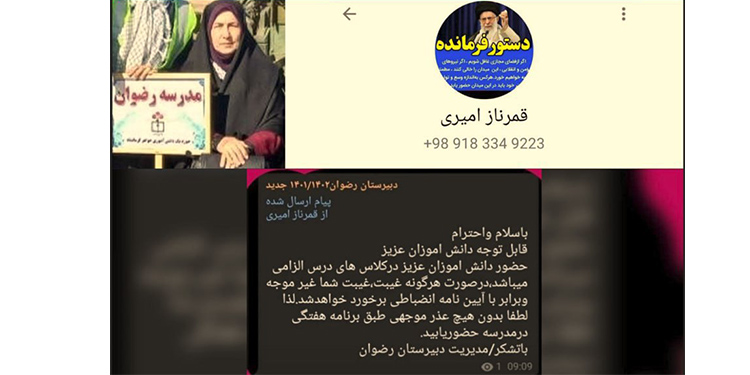
A School That Chose Not to Protect a Girl at Risk
In many countries, when a student reports a credible threat of domestic violence or murder, educational authorities are required to notify child protection agencies and take immediate action to ensure the student’s safety.
Under the educational system of Iran’s misogynistic clerical regime, however, the safety of girls is often not treated as a priority.
In Sogand Sayyadi’s case, a student’s repeated warnings that she faced the threat of murder were ignored. Instead of receiving protection, she was sent back to the very environment she feared.
This failure cannot be viewed merely as individual negligence. It reflects a broader culture in which a father’s control over his daughter is often given greater weight than her right to safety, protection, and life.
A Victim of Domestic Violence and Separation from Her Mother
Sogand lived with her father and stepmother.
Her parents had separated several years earlier, and according to reports, her father had prevented her from maintaining contact with her mother.
As a result, Sogand was deprived not only of her mother’s support but also of one of the few potential sources of protection available to her.
She lived under the complete authority of the same person who ultimately became her killer.
Sogand’s Murder and a Misogynistic System
The murder of Sogand Sayyadi cannot be attributed solely to the actions of one man.
The crime took place within a system where girls often lack effective legal protection and where warnings of danger are ignored even when the risk is clearly identified.
The case recalls the killing of Romina Ashrafi, the 14-year-old girl who repeatedly pleaded not to be returned to her father because she feared he would kill her. Despite those warnings, the judge presiding her case returned her to the same environment, and she was later murdered.
Sogand Sayyadi also asked for help.
She warned school officials that her life was in danger.
No one protected her.
Her murder once again raises a fundamental question: when a teenage girl clearly states that she faces the threat of being killed and is nevertheless sent back into the same violent environment, does responsibility rest solely with the killer, or also with the institutions that failed to carry out their most basic duty to protect her life?