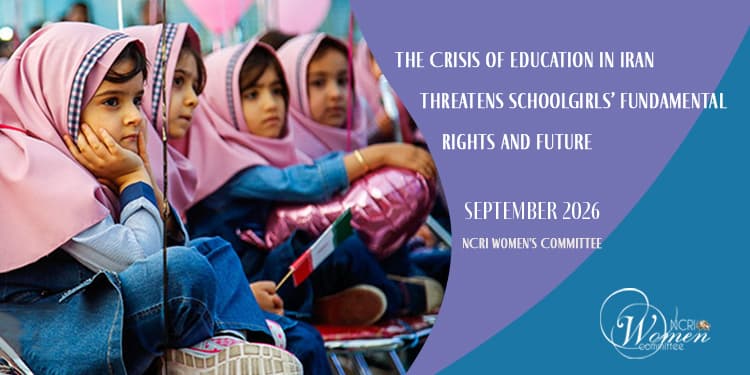
As the new academic year (2026–2027) begins, official regime media reports present an alarming picture of the crisis of education in Iran, marked by a steep drop in first-grade enrollments, rising dropout rates, worsening learning poverty, deteriorating educational quality, chronic teacher shortages, and intense economic pressure on families.
These intersecting factors have created a deep crisis within Iran’s education system, which forms the focus of this September 2026 report by the Women’s Committee of the National Council of Resistance of Iran (NCRI).
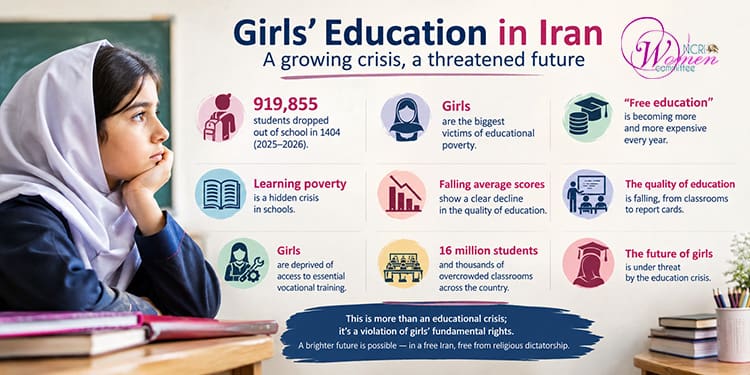
Schoolgirls bear a disproportionate burden of this crisis. Widespread poverty forces many young girls to abandon their education entirely. Even for those who manage to stay in school, declining academic standards, inadequate facilities, and restricted access to vocational training severely stifle their future opportunities.
Declining Enrollments and Soaring Dropout Rates
State officials have acknowledged the shrinking student body and growing number of children denied an education:
- Drop in First-Grade Enrollment: Ali Farhadi, Deputy Minister of Education, announced at the start of the school year that first-grade elementary enrollment stands at approximately 1,000,154 students, representing a sharp decrease of 160,000 students compared to the previous year. (IRNA News Agency, September 22, 2026)
- Over 140,000 Children Left Behind: Rezvan Hakimzadeh, Deputy Minister of Education, stated on school reopenings that more than 140,000 children were deprived of education over the past year, over 54,000 of whom were first graders. She added that girls account for 44.55% of those out of school. (Rokna News Agency, September 21, 2026)
- National Crisis Spreads to Capital: Official statistics released in 2025 by an advisor to the Minister of Education placed the total number of children deprived of education at 919,855. However, the issue today is not merely the sheer magnitude of this figure, but the alarming spread of this phenomenon to the capital, Tehran. (Fararu Website, September 8, 2026)
Out-of-School Children: A Crisis Reaching Tehran
For years, school dropouts were largely attributed to underprivileged border regions and remote provinces. However, recent state media reports reveal that the crisis has now engulfed major metropolitan areas, including the capital city, Tehran.
The sharp increase in out-of-school children in Tehran raises a critical question: Are these students unwilling or unable to attend school? Reports confirm that severe economic hardship and mounting financial pressure on families are the primary drivers forcing children out of the classroom. (Fararu Website, September 8, 2026)
Concurrently, official statistics on dropouts highlight that denial of education has evolved into one of the most critical structural threats facing Iran’s education system. (ISNA News Agency, July 9, 2025)
Afkham Sabbagh, CEO of the MehroMah Charity Organization, which supports vulnerable children, stated: “School dropouts are most widespread among the vulnerable lower income deciles. These children are inevitably forced directly into the labor market.”
Data clearly correlates skyrocketing inflation with the rising number of children deprived of education. As inflation surged from 9% in 2016 to 69.9% in August 2026, out-of-school numbers escalated in tandem:
- 2016–2017 Academic Year: Official figures recorded 777,862 out-of-school children.
- 2024–2025 Academic Year: Unofficial estimates placed the figure at nearly 1,000,000.
- 2026–2027 Academic Year: Projections indicate that at least 950,000 children will be denied education this school year. (Shargh Newspaper – September 13, 2026)
The rapid spread of this trend demonstrates that the denial of education is no longer merely a localized issue; it has become an integral part of a pervasive socio-economic crisis across Iran.
Free Education Becoming Increasingly Costly Each Year
Amid widespread poverty and shrinking purchasing power, education in Iran has effectively transformed into an expensive commodity for Iranian families.
Families face a barrage of official and unofficial expenses. From registration fees and stationery to uniforms, school transportation, and mandatory “voluntary” donations, these costs place an immense burden on household budgets. For instance, the price of stationery has surged by approximately 100% compared to last year. (ISNA News Agency, August 29, 2026)
A mother of a female student in District 1 of Tehran—a middle-class family—shared that registering her daughter required setting aside several months of her salary. She added:
“When you add up all the expenses, the final figure is far higher than we initially imagined… For a middle-class family, paying several hundred million Tomans for one child’s education is extremely heavy. If you have two school-aged children, this amount effectively turns into a massive annual expense.” (Asr Iran, September 19, 2026)
The cost of preparing a single student for the school year now ranges between 20 and 30 million Tomans. (Eghtesad News, September 22, 2026)
For families living on a worker’s wage or female-headed households with two or three children, covering these educational expenses creates double the pressure. Even if a family earns a monthly income between 15, 20, or 25 million Tomans, balancing school costs alongside housing rent, healthcare, food, and other living expenses imposes an unbearable financial strain. (ILNA News Agency, September 22, 2026)
The natural consequence of this trend is a higher probability of dropouts among low-income households—a trajectory that leaves young girls more vulnerable than anyone else.
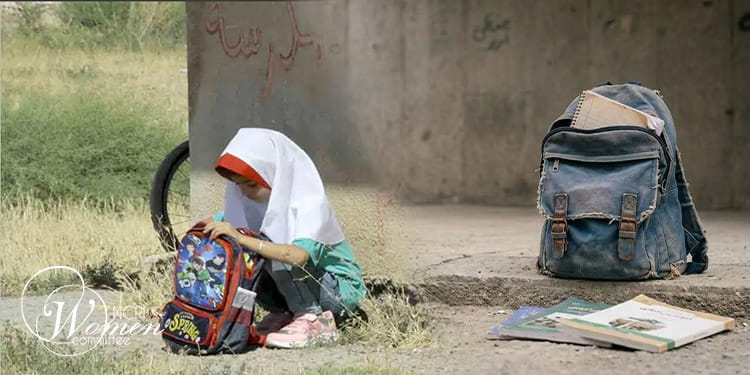
Girls: The Most Vulnerable Victims of Educational Poverty
Although the education crisis in Iran impacts all students, young girls constitute the most vulnerable group in the face of this trend.
The rate of female school dropouts has reached unprecedented levels. In many low-income households, when covering educational expenses becomes financially unsustainable, girls are far more likely than boys to be removed from the education system.
Seyyed Mohammad Bathaei, head of the Social Affairs Organization, previously stated that the number of female student dropouts is a significant figure. However, he failed to provide any transparent statistics. Commenting on the issue, he added: “This issue serves as an alarm bell for us. Special attention must be paid to this alarm!” (Shargh Newspaper, February 17, 2025)
Far from being heeded, this warning bell has been utterly ignored. Today, countless schoolgirls are forced to abandon their education due to poverty and their families’ severe economic hardships. For these young girls, being deprived of an education is not merely the end of their schooling; it means the permanent contraction of their economic, social, and professional opportunities for the rest of their lives.
Learning Poverty: The Hidden Crisis in Classrooms
The education crisis in Iran extends far beyond those who are forced out of the school system. Millions of other students attend class every single day yet are systematically deprived of mastering basic educational content.
The concept of “learning poverty” has increasingly entered Iran’s educational discourse. Learning poverty describes a scenario where a student physically attends school but fails to acquire fundamental skills such as basic reading, writing, and comprehension. (ISNA News Agency, May 19, 2025)
This phenomenon is critical because it reveals that simple school attendance does not equate to effective education. A significant portion of students progress through years of schooling only to graduate without the essential competencies needed to pursue higher education or successfully integrate into society.
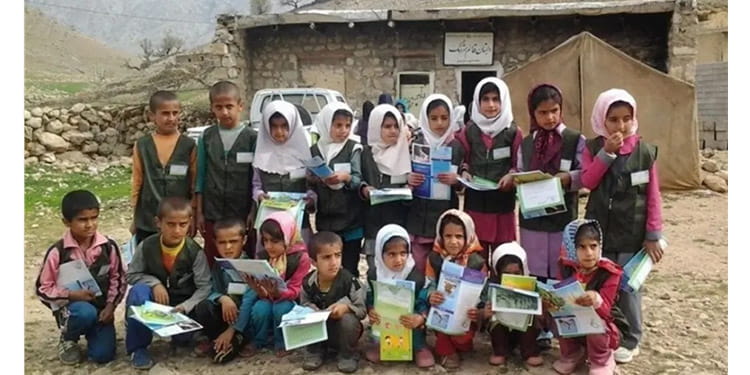
For young girls in marginalized regions, the impact of learning poverty is vastly amplified. Denied access to supplementary learning materials, remedial tutoring, and educational resources, they suffer disproportionately from the systemic collapse of educational quality.
Plummeting Grade Point Averages: Clear Evidence of Collapsing Educational Quality
Iran’s Ministry of Education has suffered for years from severe resource deficits, stark educational inequality, low teacher pay, decaying school infrastructure, vast disparities in school quality, and constantly shifting policies—systemic issues that are simply passed down from one administration to the next. (Tabnak News, August 21, 2026)
A report published in November 2025 regarding the sharp drop in final examination scores emphasized that declining grades are no longer attributable to individual student performance, rather directly stem from structural flaws within the educational regime itself. (ISNA News Agency, November 6, 2025)
At the same time, commentators highlighted the widespread emergence of borderline passing grades—a phenomenon where vast numbers of students manage to score barely above the minimum threshold required to pass. (Tabnak News, August 21, 2026)
Prior reports had already warned that the Ministry of Education had entered a “red zone,” with average student scores dropping into the abysmal 8-to-10 range (out of 20) in several national assessments.
The Collapse of Educational Quality: From Classrooms to Student Report Cards
Official data from national final examinations clearly illustrates a sharp, year-over-year decline in academic performance across key academic tracks—including Empirical Sciences, Mathematics & Physics, Humanities, and Islamic Sciences:
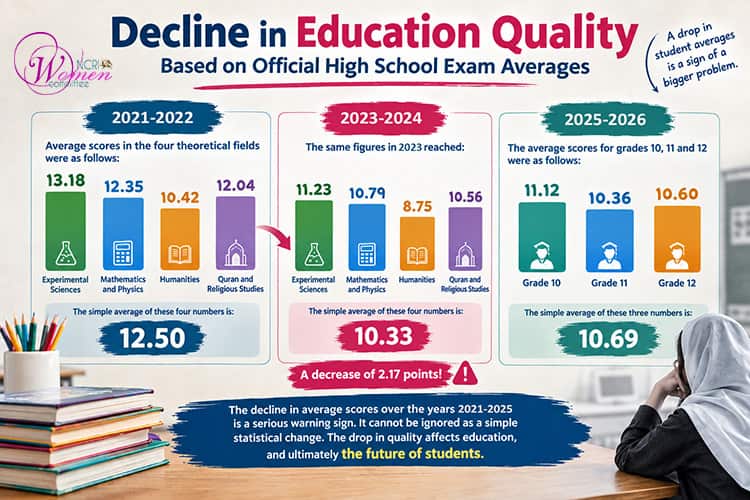
- 2021–2022 Academic Year: Average scores were recorded at 13.18 (Empirical Sciences), 12.35 (Math & Physics), 10.42 (Humanities), and 12.04 (Islamic Sciences)—yielding an overall simple average of 12.50 (out of 20).
- 2023–2024 Academic Year: Scores plummeted across all disciplines to 11.23, 10.79, 8.75, and 10.56, respectively—dropping the overall simple average down to 10.33. This steep decline of approximately 2.17 points serves as a stark warning sign that cannot be brushed aside as mere statistical fluctuation.
- 2025–2026 Academic Year: Official average scores across high school levels remained critically low, standing at 11.12 for 10th grade, 10.36 for 11th grade, and 10.60 for 12th grade—resulting in a simple overall average of just 10.69.
These official figures confirm that deteriorating educational quality has evolved from an administrative shortcoming into a full-fledged structural crisis within Iran’s school system.
16 million Students and Thousands of Overcrowded Classrooms
The collapse of educational quality cannot be understood without examining the state of Iran’s educational infrastructure.
On the eve of the new school year in September 2026, state media reported that approximately 16 million students entered the academic year—facing thousands of severely overcrowded classrooms. Among them are 7.7 million young girls, who bear the brunt of these congested learning environments. (Rouydad24, September 6, 2026)
Rezvan Hakimzadeh, Deputy Minister of Primary Education, acknowledged that the ideal primary class size is 20 students, with an absolute maximum limit of 26. Highlighting how far Iran lags behind international standards, she stated, “When we have classrooms with densities exceeding 35 or 40 students, the instruction time each student receives from the teacher differs significantly compared to a student in a smaller class, directly impacting learning. We will need at least another decade to reduce class sizes to an acceptable level.” (Asr Iran, September 18, 2026)
Overcrowded classrooms drastically diminish individualized instruction, while chronic teacher shortages further degrade the quality of education. The direct result is plummeting student comprehension and a widening educational divide between privileged and impoverished regions.
For young girls, particularly in marginalized areas, this crisis is compounded by additional structural barriers, including a severe shortage of female teachers and severely restricted access to basic educational amenities.
Alongside high class density, persistent shortages of both qualified teachers and adequate physical school spaces remain deep-seated vulnerabilities of Iran’s education system.
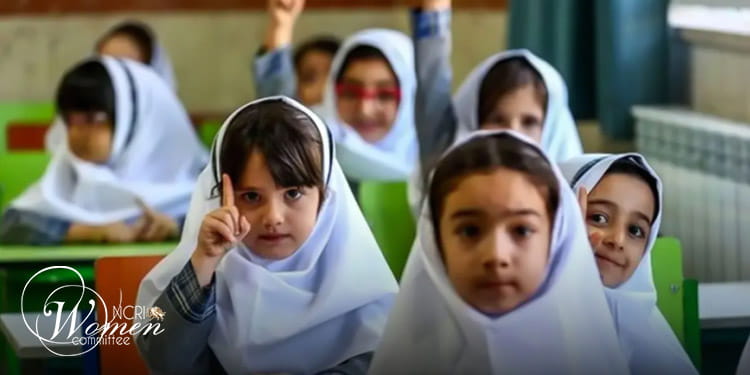
The Education Crisis in Iran Threatens the Future of Young Girls
When these intersecting elements are viewed together, a clear picture emerges. Skyrocketing dropout rates, unprecedented numbers of young girls denied an education, widespread learning poverty, falling grade point averages, persistent teacher shortages, and deepening economic misery are all interconnected components of a single, systemic crisis.
Schoolgirls stand at the very epicenter of this disaster. They are not only far more vulnerable to being forced out of the school system entirely, but even those who manage to stay face a compromised future due to the precipitous collapse of educational standards.
Reports from state media throughout 2025 and 2026 demonstrate that education in Iran is suffering from a structural collapse—a crisis that, for an ever-increasing number of Iranian girls, has transformed school from an avenue of opportunity into a battleground of poverty, discrimination, and state-imposed limitations.
Consequently, the crisis of education in Iran extends far beyond academic institutions; it directly threatens the fundamental rights, dignity, and future of young girls.
The inevitable fallout of driving young girls out of school is chaining their fate to a relentless cycle of social harms; a vicious pipeline that begins with child labor or forced child marriage, escalates through domestic violence, and ultimately leaves them victims of the misogynistic laws of the clerical regime. It is a painful trajectory that, in far too many tragic cases, leads all the way to the gallows.